
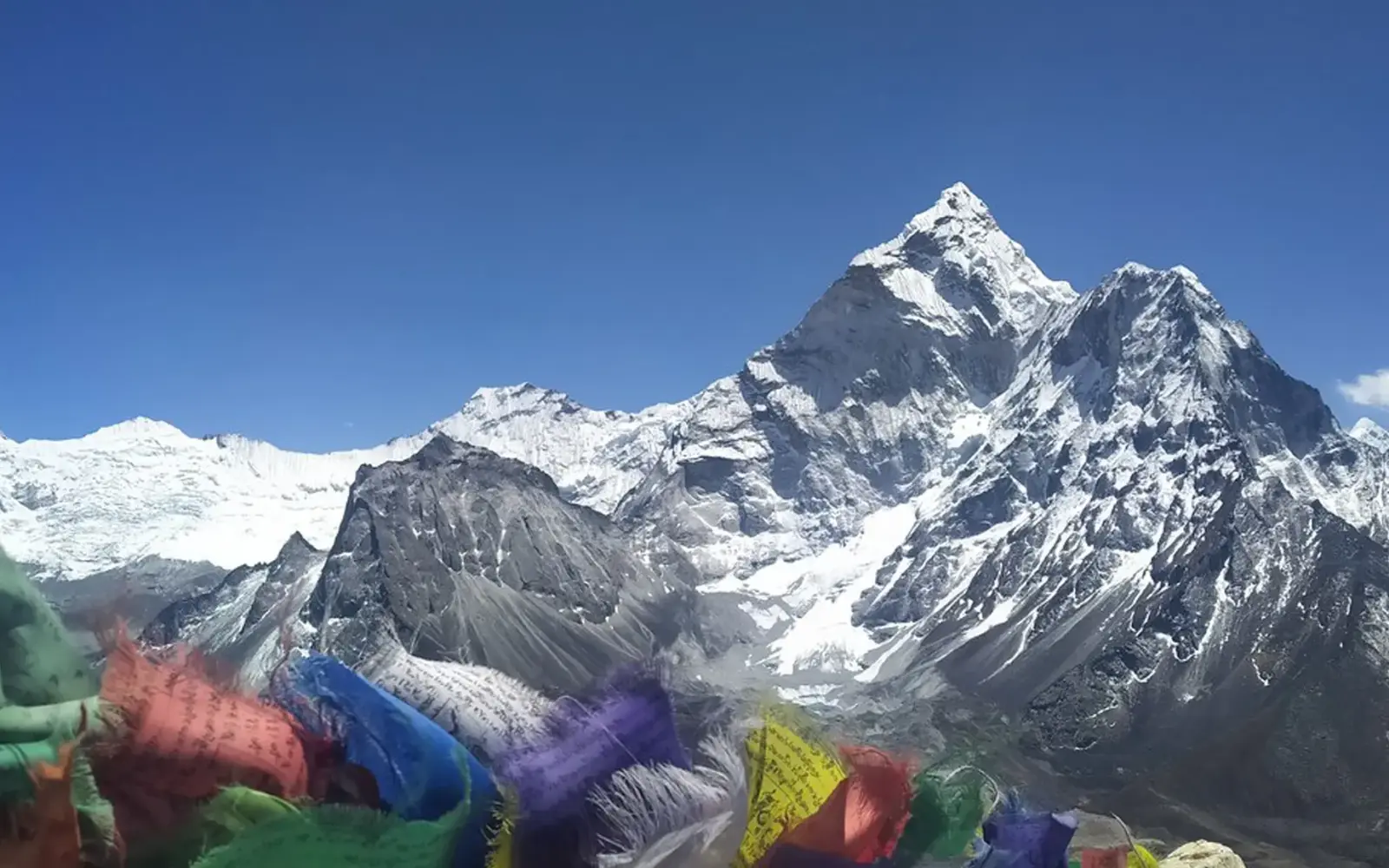
Everest Base Camp (EBC) is the world’s most famous trek. In this 11-day package, you trek the classic EBC route and fly out by helicopter from Gorak Shep (above base camp) to Kathmandu. As All Himalaya Treks explains, you trek from Kathmandu to Lukla, ascend through the Khumbu to Everest Base Camp, and then ride a helicopter back to Kathmandu. This blog breaks down Everest Base Camp trek costs in detail – from flights and permits to meals and the helicopter – using All Himalaya Treks’ official package and other sources. We’ll cover what’s included, what’s extra, seasonal price changes, group discounts, and tips for saving money, so you can plan your trek with confidence.
Prices vary by operator, group size, and season, but a shared-group helicopter-return trek typically runs in the low‑to‑mid USD 2,000s per person. For example, one trekking blog estimates $2,000–2,700 per person for a standard good-quality trek + helicopter return in a group. All Himalaya Treks’ published rates are in this range. Their 11-day EBC with helicopter package is listed at US$2,350 for a solo traveler, with group discounts down to $1,900 per person for a 10–16 person group. (Solo travelers pay more; larger groups benefit from sharing costs.) In general, expect to pay around $2,000–2,400 per person for a group-trip package including the helicopter, though exact prices depend on timing and inclusions.
For context, a private helicopter-return trek can be even higher (some operators quote up to $4,000–6,000 for a luxury/solo booking). By contrast, a standard 12–14 day EBC trek without helicopter is cheaper (often in the range of $1,200–1,700 per person in a group). In short, adding the helicopter increases the price significantly, but it also saves days and adds a unique aerial finale.
Planning your budget, consider these major components:
In summary, the helicopter-return trek bundle includes all the above (flights, permits, lodging, meals, guide/porter, helicopter) in one price. But if you were to pay each piece separately, you’d find: $400–500 for flights (Ktm–Lukla return), $60 for permits, $100 for Kathmandu hotel, $100–200 for trek meals (if not included), $400–500 for guide/porter labor, and about $1,000 for the helicopter. That adds up to roughly the same total.
Your trip starts with a flight into Nepal. International round-trip airfare (to/from Kathmandu) can be $600–1,200 or more depending on origin. (These are not included in most trekking packages.)
Once in Kathmandu, you fly to Lukla (2,800m) – the gateway to Everest. Kathmandu–Lukla domestic flights take about 30 minutes and cost roughly $180–$230 one-way per person. All Himalaya’s package covers this one-way flight to Lukla, but remember you still need the helicopter return (see below). In peak season (spring, autumn) Lukla flights fill up fast; book as early as possible. Some trekkers save by flying Lukla–Kathmandu on the helicopter itself, but most itineraries use the helicopter only for the return leg.
Trekking in the Everest region requires two permits: the Sagarmatha National Park entry permit and the Khumbu (Pasang Lhamu) Rural Municipality permit. Together these cost about NPR 6,000 ($60) for foreign visitors. (Sagarmatha NP permit is NPR 3,000 $30; the local government permit is also NPR 3,000 $30.) Agencies like All Himalaya arrange and include these permits for you. Note: the old TIMS card is no longer required in the EBC region, having been replaced by the local permit. You’ll also need a tourist visa for Nepal ($30 for 15 days) which is paid on arrival, not included in the trek price.
Your package includes 11 nights of accommodation during the trek plus 2 nights in Kathmandu. In Kathmandu All Himalaya provides a 3-star hotel (approx. $50–100 per night in high season). On the trail, you stay in family-run tea house lodges, usually in twin/double rooms. These are simple but adequate: a bed (often bunk beds), shared bathroom (or sometimes attached in higher villages), and hot shower (for a small fee). Teahouse lodging is very affordable – roughly $3–10 per night for a basic twin room. It’s common to pay more (up to $30–40) for nicer lodges or single rooms, but budget treks stick to the basic range. All Himalaya’s cost assumes twin-sharing; solo travelers must pay a single-room supplement if available.
During high season (spring/autumn) lodge rooms can be in short supply, so book early. Conversely, in the off-season (monsoon/winter), some places close and remaining lodges may raise prices to cover lower occupancy. But generally speaking, your lodging cost per night is only on the order of $5–10 at most stops, so it’s a modest part of the budget. All Himalaya handles your booking each night, which is one reason to use a company (they know the best lodges and handle pay-on-arrival logistics).
Food on the trail is simple but filling. Dal Bhat (lentils & rice) is the staple and typically included in tour meals. Other common dishes: momos (dumplings), noodles, soups, or even pasta/pizza in larger villages. Since everything must be ported in, prices are higher than Kathmandu: a dinner might cost $5–15, lunch $3–10, breakfast $3–5. All Himalaya’s package includes all meals on trek (breakfast, lunch, dinner each day), which provides huge savings and convenience.
If you had to pay as you go, plan on about $25–35 per day for food and drink. Snacks (energy bars, biscuits) and bottled water are extra. Many trekkers buy water purification tablets and drink boiled/filter water for $1/L. Remember that during the trek we recommend drinking plenty – roughly 3–4 liters a day – so even at $1/L that’s a few dollars daily. In short, food and drink cost is only a few hundred dollars total for the trek, a minor fraction of the package when bundled.
Professional support is included in the package, which is a cost saver. Guides: All Himalaya provides a licensed English-speaking guide. Guides make $25–35 USD per day. Porters: The company gives you one porter for every two trekkers, each porter carrying up to 30 kg of your gear. Porters earn around $20–25 per day. (These wages are typical in Everest region.) The package covers the guides’ and porters’ salaries, insurance, equipment, and food – so you don’t pay them directly, just a tip if you wish.
Even though their wages are included, it’s customary to tip after the trek. A common guideline is $100–150 total for a guide and $50–70 for a porter (for an 11-day trek). This is outside the package price and shows appreciation for good service. Also note: porter pay and conditions are regulated; you should insist porters carry a reasonable load (20–25 kg) to avoid overwork. The package also includes support staff logistics, so you can focus on trekking.
The helicopter is the most expensive single component. A flight from Gorak Shep (or nearby Kala Patthar) to Kathmandu cuts about 3–5 days of descent. Helicopters also occasionally refuel at Lukla on the way, but it’s essentially a direct return.
Cost depends on sharing. According to one Everest helicopter service, a shared Gorak Shep to Kathmandu flight is about USD $950–1,200 per person (helicopters seat 5, so cost is divided). If you charter the entire helicopter privately, it can be $3,400–3,600 total (still around $700–900 per person if 4-5 people share). In All Himalaya’s pricing, the helicopter cost is bundled into the package. If you looked at it separately, expect roughly $1,000 on top of the cost of the trek.
This premium covers fuel, pilots, maintenance, and the fact that flying at 5,000+ meters is technically challenging. Keep in mind weather can sometimes delay or cancel flights; a good agency has backup plans (e.g. return via Lukla flight the next day if needed). All Himalaya includes one helicopter return per person in the package.
Seasonality has a big effect on cost. The peak trekking seasons (pre-monsoon spring Mar–May and post-monsoon autumn Sep–Nov) have higher prices and demand. During spring/autumn, Lukla flight prices rise and lodges often hike rates. All Himalaya even labels Mar–May and Sep–Nov as Best Season because of the weather and views. If you trek in these months, expect to pay the full listed price.
Off-season (Monsoon Jun–Aug, or mid-winter Dec–Feb) can be cheaper on paper: flights to Lukla and lodges may discount, and package rates sometimes drop. However, flights are frequently cancelled in monsoon due to rain, and winter brings snow on the trail and extra gear needs. Some agencies offer discounted rates for shoulder-season trips, but be cautious. As one budget guide advises, choose to fly into Kathmandu during the off-season when airfare is cheaper and consider shoulder months (late Nov or early Mar) for balance.
In summary, peak season = higher prices & guaranteed service; off-season = potential savings but more risk. If your dates are flexible, booking a shoulder-season trek just before/after the crowds can save a few hundred dollars.
Group size strongly affects your per-person cost. All Himalaya Treks explicitly offers group discounts: a solo trekker pays $2,350, while a party of 10–16 pays just $1,900 each. (That’s a $450 discount – about 19% – for large groups.) This reflects sharing fixed costs (guide, helicopter, etc.) among more people.
In general, larger groups = lower price per person. Many companies price EBC helicopter return trips with tiered rates. For example, Nepal Trek Adventures also lists around $2,250 for a group trek. By contrast, a private or solo booking often incurs a hefty premium (some operators list solo rates up to $3,000–4,000). As a rule of thumb, sharing a trek (friends or a public group) will save you money.
Even in a group, prices can vary by amenities (deluxe lodges, private heli, etc.). As one industry summary notes, a standard helicopter return package is $2,000–2,700 pp in a group, whereas luxury/private tours can reach $4,000–6,000. So if budget is a concern, aim to join a group trek rather than booking entirely solo.
Choosing a helicopter return is convenient but carries a cost premium. On one hand, helipads save time, energy, and offer spectacular views. On the other hand, you could skip the helicopter and trek back the normal way, which is much cheaper. Here’s a quick comparison:
Bottom Line: If budget is tight and you have time, hiking back saves money. If you’re short on days or prefer comfort (or simply want the once-in-a-lifetime helicopter ride), the extra $1,000 for the heli return can be worth it. Many trekkers split the difference by taking the heli down but stopping at Lukla to fly on to Kathmandu by plane – essentially the same route as a full helicopter but in two legs (Gorak Shep to Lukla heli, Lukla to Kathmandu plane), which All Himalaya does.
It is up to you to decide whether the helicopter-return trip is worth it or not. Here are some pros and cons:
In practical terms, for first-time trekkers or those concerned about altitude, the helicopter offers peace of mind (you won’t struggle down the trail). For experienced trekkers on a tight budget, walking back might be preferred. All Himalaya’s clients often choose the helicopter for the “comfort after a long day of treading a trail” and the memorable ending over Everest. Ultimately, the “worth” is personal: the package’s positive reviews suggest many find the extra cost justified by the saved days and spectacular flight.
If you’re looking to cut costs, consider these tips:
Following these can shave off a few hundred dollars. For example, trekking agencies often offer last-minute discounts in low season. However, don’t skimp on essentials: travel insurance and permits, for instance, should not be cut.
The Everest Base Camp Trek with a helicopter return is an unforgettable but premium experience. At roughly $2,000–2,500 per person (for a shared-group booking), it’s significantly pricier than the conventional trek. However, that price covers nearly everything – flights, permits, meals, lodging, guide/porter, and the helicopter itself. In return, you get an epic 11-day Everest adventure without the extra days of descent, and an incredible aerial finale.
When budgeting, break down the costs: domestic flights ($225 one-way), permits ($60), lodging ($5–10/night), food ($30/day), guide/porter wages ($25–35/day), and of course the helicopter ($1,000). All Himalaya Treks’ package neatly bundles these, with clear inclusions and exclusions (see their official breakdown).
In the end, the value depends on your goals: if you want to save time and get a once-in-a-lifetime helipad view of Everest, the extra cost can be justified. If budget is very tight and you have time, trekking back on foot will save money (roughly $700 on a $2,200 package). Whichever way you choose, understanding the Everest Base Camp trek cost in detail helps you plan wisely and avoid surprises.


