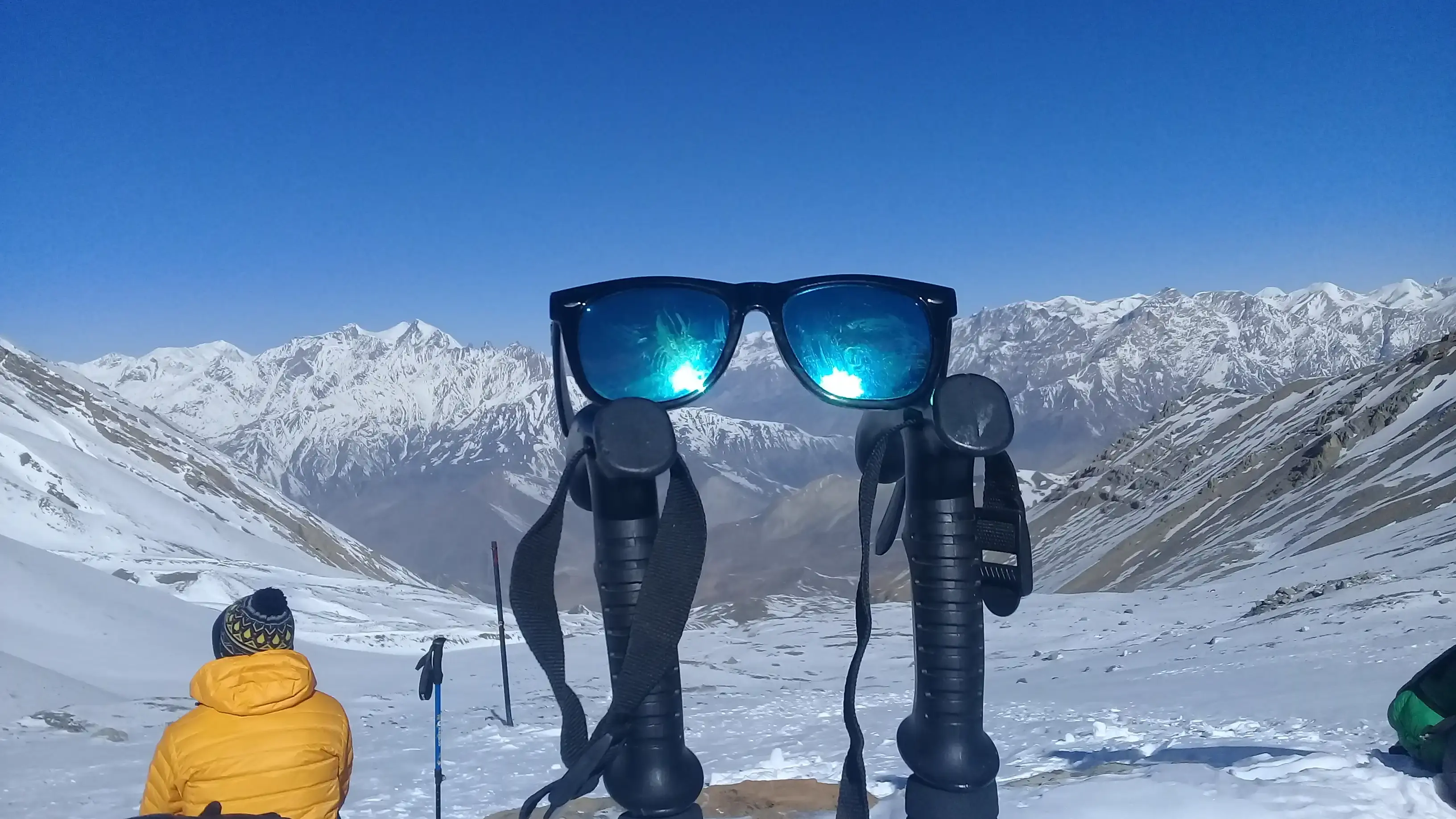
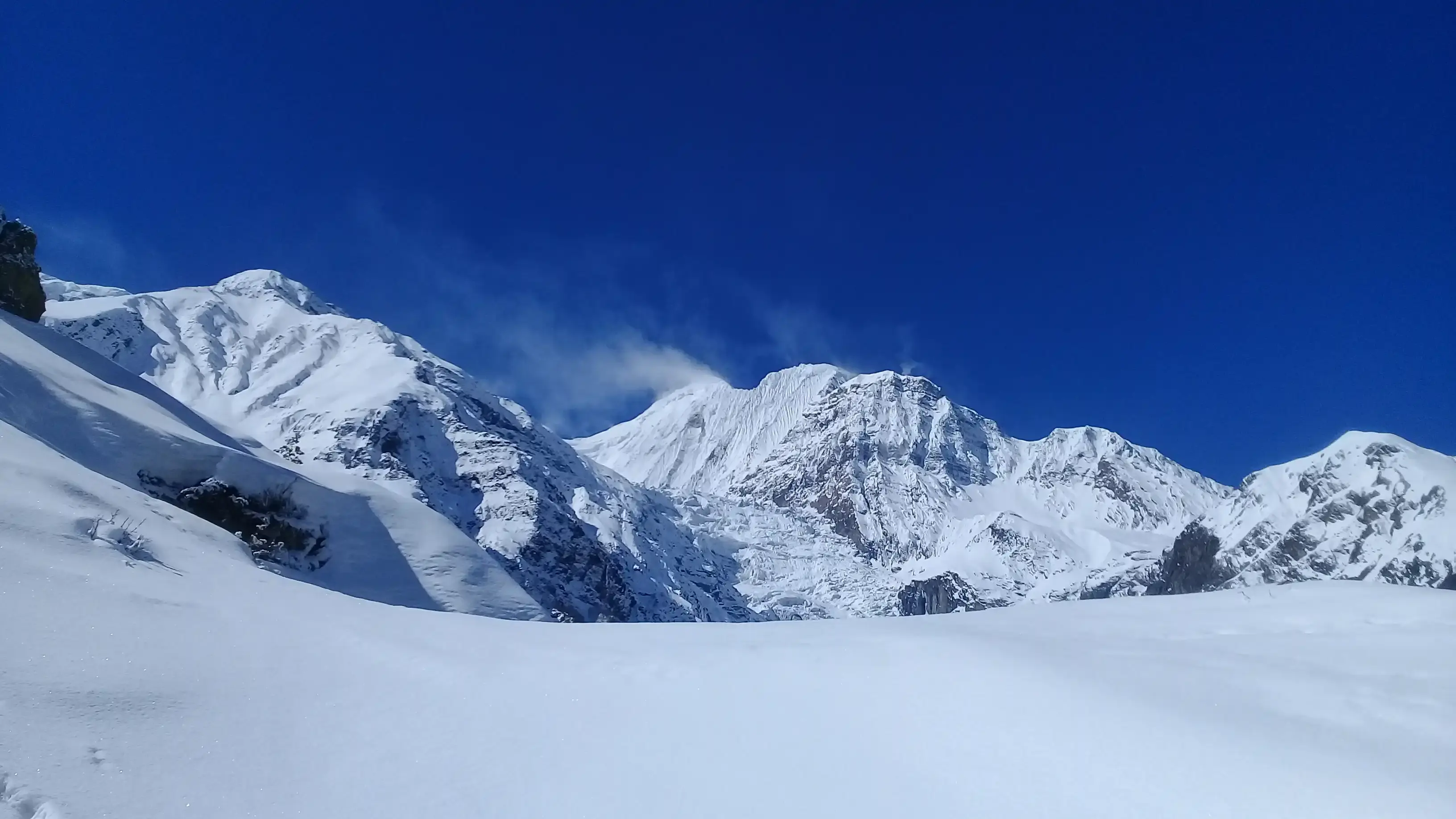
The Annapurna Circuit trek has remained a classic hiking destination that, for many, has always been a dream. Its geographical and mental uniqueness, the rugged mountains that surround it, and the mystical aura that still lingers in the area are perhaps some of the reasons that make our Annapurna Circuit trek an essential stop for all who visit Nepal.
Known as an athletic hiking adventure, the Annapurna Circuit trek is also a heaven for mountaineers, as the route takes you around the breathtaking Annapurna I (8091 m), which still stands as a challenge in the form of the 10th-tallest peak in the world.
However, the Annapurna Circuit trek is also about the captivating landscape of the 7269 square km of the Annapurna Conservation Area that will not stop enchanting you each moment you spend in the region.
In every moment, you will feel the commanding presence of Khatung Kang (6484 m), Gangapurna (7455 m), Hiunchuli (6441 m), Gundang (5312 m), Manaslu (8163 m), Pisang (6091 m), Annapurna I (8091 m), II (7937 m), III (7555 m), IV (7525 m), South (7219 m), Lamjung (6983 m), Tilicho (7134 m), Fishtail (6993 m), Sangang, and Nilgiri.
It also takes you deeper into the Buddhist religion of the Magar and Gurung communities and the Hindu beliefs of the Thakalis, Brahmins, and Chhetris.
Thus, our 14 days Annapurna Circuit trek is also about the embracement of human warmth, where the essence of both Hindu and Buddhist culture will amaze all your senses.
So, if you are looking for a true symphony of nature and religion, monasteries, temples, and mountains, then the Annapurna Circuit trek is your ultimate journey.
It requires considerable effort, yes, as there will be the enormous 5416 m altitude of Thorong La Pass (the world’s highest trekking mountain pass) in the middle. But the adventure and unforgettable experiences it provides are absolutely worth it.
Our Annapurna Circuit trek itinerary will take you from bustling Kathmandu to Bhulbhule, where your trekking adventure begins amid the stunning scenery stretching from the peaceful Lamjung to the magnificent Manang Valley.
You will rest for a day in the evocative mountain village of Manang, where the beautiful Gangapurna Lake, the legendary Milarepa Cave, and the breathtaking Chongkor Lookout tower will stand in line to enchant you.
Next, our Annapurna Circuit trek route will ascend you to the Thorong La Pass from where you will descend to Muktinath, a major pilgrimage destination for Hindus and Buddhists alike.
The Kali Gandaki Valley of the Thakalis will then lead you to the relaxing natural hot springs of Tatopani. The trail of our Annapurna Circuit trek will then lift you to the impressive height of 3210 m of Poon Hill, where you will witness a sunrise that you won’t soon forget.
The route will then take you back to Pokhara and Kathmandu. The counterclockwise route of our Annapurna Circuit trek is therefore sure to provide you with an intense experience that will surely connect your soul to the Himalayas of Nepal.
Inviting in spring and autumn, our 14 days Annapurna Circuit trek is the best choice for both experienced and newcomers as it is moderate, less intense, and involves spending less time at high elevation.
The Annapurna Circuit trek has now become the most frequented destination in Nepal. Some trekkers even imply that it has lost some of its charm due to commercialization and road development.
However, it still continues to be the classic route in Nepal that motivates trekkers to undertake it at least once, and the reasons are:
The Annapurna Circuit trek generally takes 14 to 18 days to complete, which includes a few rest days. However, it is also possible to complete the trek in a shorter time.
It is because there has now been access to a motorable road along most parts of the journey. By using a jeep, you can shave off a couple of days, so there is less reliance on your feet, making the Annapurna Circuit trek comparatively shorter, quicker, and more comfortable.
Thorong La Pass is the highest mountain hiking pass in the world, which is also the highest altitude of our 14 days Annapurna Circuit trek. The journey to the pass is non-technical but long.
But once you are at the summit, the stretching mountain panorama all the way to Tibet will make every moment worthwhile.
Each moment of the Annapurna Circuit trek itinerary will pass as an enchanting memory as you will be able to observe the immense features of the Annapurna and Dhaulagiri range, such as Annapurna I, Annapurna II, Annapurna III, Annapurna IV, Annapurna South, Dhaulagiri, Nilgiri, and Machhapuchhare.
The Annapurna Circuit Trek enables you to interact with the vibrant community of the Gurung, Magar, and Thakali groups. You will experience their warm hospitality, distinctive traditions, and traditional architecture in the various villages.
You will have much-needed relaxation at the thermal waters of Tatopani toward the conclusion of the Annapurna Circuit trek, an excellent way to end the tiredness accumulated along the long journey.
When you are at Manang, you can engage in a half-day trek to reach the high ice lake of Gangapurna, created by the waters from the Gangapurna Glacier. This hike will serve as a precursor to Thorong La Pass and also help in acclimatization.
After the pass, you will have the religious opportunity to explore the vast complex of the Muktinath Temple, revered by Buddhists and Hindus. Bathing under the 108 holy springs known as Mukti Dhara is believed to lead to salvation.
The early morning ascent to Poon Hill will display the most beautiful sunrise of your life, where you will see the Annapurna and Dhaulagiri ranges greeting the early-wakening sun.
All Himalayan Treks Pvt. Ltd. was founded by Mr. Nirmal Gurung in the tourist capital of Thamel in Kathmandu. He himself is the son of the Ganesh Himal region and has years of experience as a reliable mountain hiking guide.
Thanks to his practical knowledge and expertise, today, the company has emerged as one of the leading trekking and travel companies that has been organizing a wide range of treks and tours in every corner of Nepal.
The company also has a team of skilled professionals, from experienced guides and porters to management staff who can tailor-make the travel experience, leaving each guest 100% satisfied and fulfilled after their trip.
Moreover, the company prioritizes the safety and security of all guests and provides prompt and effective rescue management during emergencies.
The company is also fully committed to environmental safety, earning the trust of each guest over the years. We also believe in offering a personalized experience for every guest, which is why we interact with each of our clients, thus fulfilling their every requirement.
Let’s get straight to the start of our Annapurna Circuit trek. After breakfast, we will travel to the starting place of our 14 days Annapurna Circuit trek.
From Kathmandu, we will cross the Thankot Pass and descend via Prithvi Highway into the Trishuli Valley. Glancing at the commanding profiles of Ganesh, Annapurna, Lamjung, and Langtang peaks, we will travel upstream to Dumre.
The Marshyangdi River will emerge guiding our way to Besisahar (760 m). Now the narrow switchback road of the Lamjung district will move us ahead through Khudi to Bhulbhule, a village with enticing scenery and mountain views.


Our real mountain hiking adventure commences from today. From Bhulbhule, the terraced fields and tracks will move us through various individual villages of the Gurung community, such as Nagadi (930 m), Dobhantar, Ghermu, Bahun Danda, and Syange, before we find a beautiful shelter in Jagat.
This small Gurung town is the administrative and tourist hub of the Lamjung District, decorated by the dominating views of the Annapurna and Manaslu peaks.
Our hiking route today will go through a slender valley bordered by amazing rock cliffs. After Jagat, the path will elevate along the rocky face for around 2 hours, taking us to Chamje Village (1430 m).
Here, the Marshyangdi River will be on our way, and so we will cross its vast currents over a suspension bridge. The rockier terrain will continue to be more slender and uphill as we move to Tal (1700 m).
The narrow valley of Manang has started giving us a detailed insight into the typical Tibetan culture. The stretch of the Mani Walls and stone houses will then ascend us through Karte to Dharapani Village.
Today, the trail of our Annapurna Circuit trek will guide us through the very beautiful gorges, dense woodlands, and breathtaking waterfalls. After Dharapani, the path will initially move ahead along a well-maintained jeep road.
Ascending comfortably, we will shortly reach Bagarchhap Village (2160 m). watching the gleaming surface of Annapurna II, we will pass through Danakyu and Timang villages.
The atmosphere now becomes more pristine as we head up to Lata Marang (2400 m) and Koto settlements beside the Phu Khola. Eventually, we will arrive at Chame, the headquarters and very busy town of the Manang Valley.
After breakfast, we will resume our trek along the trail that will lead us to Upper Pisang. En route, we will face some steep inclines, but the commanding views of the Annapurna massif will make the effort worthwhile.
After Chame, the shore of the Marshyangdi River will be our guide for around two hours, after which we will find ourselves in Bhratang settlement.
Here, we will cross a long suspension bridge over the Marshyangdi River and reach the trail beside the southern bank of the river. It will rise further inside the pine jungle, taking us to the 1500 m tall Paungdi Danda (1500 m) at Dhukur Pokhari.
Chulu, Pisang, and Annapurna Peaks command the sky here, after which we will advance to Lower Pisang Village (3200 m). For better comfort and scenery, we will push more for 100 m to reach the Upper Pisang of the Upper Manang Valley.
Our ascent will continue today, also taking us through the charming agricultural villages and unforgettable viewpoints. The trail from Upper Pisang will ascend through the drier and barren terrain, leading us to Ghyaru Village (3670 m).
We will now descend slightly and reach the Ngawal (3657 m) and Mungji villages. Climbing higher, we will shortly be exploring the small historic Gompa of Braga Village (3450 m).
Manang is now thirty minutes farther, where we will see the peaks of Lamjung, Annapurna II, III, IV, Gangapurna, and Tilicho commanding the sky.
Today, our alarm will go off early, and a stunning display awaits us that alone justifies our entire Annapurna Circuit trek: the mesmerizing sunrise over the Annapurna range. We will capture plenty of videos and photos to share them on our social media with pride.
The rest of the day is for relaxation and taking beautiful short hikes to the glacial lake fed by Gangapurna Glacier and the Cave of Milarepa. You can also go for a bit-longer hike towards the 4130 m tall Chongkor Lookout tower or the Bodzo Gompa (4130 m), or touring Khangsar Village (3756 m).
The acclimatization hike you take today will prepare you to face the challenge of the Thorong La Pass, the highest altitude of our entire Annapurna Circuit trek.
Our Annapurna Circuit trek itinerary will lead us today through the village of Yak Kharka to Letdar, which is the last settlement before arriving at Thorong High Camp.
The rugged terrain will become even rockier as we ascend from Manang to Tengi Manang (3650 m). We will now leave the richness of the Marshyangdi Valley and turn northwest and step into the Jarsang Khola valley.
A juniper thicket will assist us in reaching Ghunsang (3890 m), where we will traverse a small mountain stream. The age-old Mani Walls line up the trail as we head upward to reach the pasture of Yak Kharka. From here, we will have to push a bit more to reach Letdar, passing through the Upper Yak Kharka. Enjoy the impressive terrain and calm evening.
From now on, we will move at more steadier pace as the terrain will be even more higher and drier. From Letdar, we will gently ascend till we reach the Thorong Khola. Crossing this river, we will make another short yet steep ascent to Thorong Phedi, which is also considered the base camp of the Thorong La Pass.
However, we will not stay here and proceed further up steeply to reach the High Camp of the Thorong La Pass. Here, the terrain seems like quite otherworldly, with the peaks of Sangang, Khatung Kan, Gundang, and Thorong Peak jutting into the sky.
Today is arguably the toughest and most challenging day of our Annapurna Circuit trek. We will cross the highest hiking pass that exists in the world, the Thorong La.
From its High Camp, we will ascend 500 m of steep switchbacks and reach the summit of the pass, adorned with a multitude of colorful prayer flags.
Lamjung, Hiunchuli, Dhaulagiri, Annapurna I, Fishtail, Manaslu, and Nilgiri command the horizon here. After making some reels with these giants, we will now descend the scree fields of around 1600 m to reach the pilgrimage town of Muktinath.
We will descend through the enticing little towns of Rani Pauwa, Ekle Bhatti, and Khinga en route.
In the early morning, we will explore the prominent temple of Muktinath, an important religious site for Hindus and Buddhists. The remarkable temple complex, the 108 holy springs, ancient ruins, Vishnu Temple, eternal natural flame, and Buddhist Gompa are some important sites not to miss here.
Next, we will board a public vehicle to travel to the old red town of Kagbeni, which has long serving as an entrance to the Upper Mustang. The road is dry and dusty as we proceed further to Dagarzong and then descend towards Jomsom.
The picturesque gorges created by the Kali Gandaki welcome us, taking us toward Marpha, a well-known Apple farming region of Nepal. Further en route, we will be able to take a look at the Gurung, Thakali, and Magar cultures in Dhonga, Kobang, Larjung, Kokhethanti, Dhampu, Kalopani, and Ghasa.
Look at the famous and adventurous suspension bridge of Ghasa as you travel to Tatopani through Dana. Tatopani is a small town of hot springs where you can relax a little later in the evening.
We will reach another very beautiful destination we have planned for you in our Annapurna Circuit trek, Ghorepani. From Tatopani, we will again resume our hike and move south to cross the Kali Gandaki River.
Then, we will turn right and traverse the agricultural land of Birauta and Ghara before ascending steeply to Ghopte Kharka. Watching the edgy peaks of Dhaulagiri and Nilgiri, we will travel through Shikha, Phalante, and Chitre villages before we reach Ghorepani.
It is a small village resting atop a small hill inhabited by Pun Magar and Gurung. We will enjoy our evening walking through the local market and discovering the local culture and traditions.
Again, our alarm will go off very early so we can hike up to the most prominent viewpoint in the Annapurna region, Poon Hill.
The trek will roughly take an hour, but our moment on the hill will be rewarded by the grand display of over 15 peaks in the central Himalaya, including Dhaulagiri, Fishtail, Tukuche, Gangapurna, Nilgiri, Annapurna I, II, III, and South.
We can also glance at the Kali Gandaki Valley and the Mustang region. Now we will return to the lodge in Ghorepani for breakfast, then set out on our final trekking adventure.
We will climb to Ulleri and then descend into the valley to Tikhedhunga, and Birethanti before reaching Nayapul. We will then get in our jeep to get to Pokhara, where you can relax, or take a walk in the lakeside market, rent a boat for a trip on Lake Phewa, or indulge in a massage.
After a calm and relaxing morning in Pokhara, we will board an AC tourist bus that will travel us along the Prithvi Highway, a scenic route that takes us through the hills of Trishuli before reaching Kathmandu.
After you check into the hotel, you can enjoy your free time exploring Kathmandu at your own pace.


Your Annapurna Circuit trek will start from the warm subtropical climate of Kathmandu and slowly progress to the cold alpine climate of Annapurna.
The monsoon precipitation generally begins from June and may last till mid of September, bringing heavy daily rain. This often creates a challenging hiking condition with slippery trails and potential landslides.
Winter cold, on the other hand, begins from late December and lasts till February. The cold will be extreme in January and February, which often covers the trails to the Thorong La Pass, Manang, and Mustang in thick snow.
Therefore, the Annapurna Circuit trek is possible from March to May (spring), during autumn (September to November), and even in December.
But the best times would be in spring and autumn when you will have bright sun shining over your head with postcard-like nature surrounding you.
However, be prepared for the frosty mornings from Upper Pisang and for the windy and dusty afternoons in Jomsom, Kagbeni, and Marpha.
The Annapurna Circuit trek is a class III Upper Intermediate hiking expedition that spans around 220 km with the highest altitude of 5416 m.
The entire Annapurna Circuit trek itinerary features a steady ascent to its highest point (Thorong La Pass), but not as steeply. There will be certain days and detours that can be a bit strenuous, such as traversing the route through Upper Pisang, but this is part of the experience.
After crossing the Pass, the trail is mainly downhill and easy. Regarding the ascent to the pass, the trail is non-technical yet lengthy, which can be quite exhausting.
In terms of altitude, you will only experience two days at extreme heights. One at Manang, when you will be at 3540 m when only two stops will separate you from the Thorong La Pass.
After the pass, you will again descend back to below 4000 m. The second day will be when you take an overnight refuge at Thorong High Camp at 4925 m, and you will only ascend above 5,000 meters for a few hours during the pass.
Thus, the Annapurna Circuit trek is doable by anyone enjoying average physical fitness.
You don’t have to be an elite athlete or a mountain climber to experience the Annapurna Circuit trek. Anyone who is fit and healthy, and can tackle the trail over 2500 m, can take part in our 14 days Annapurna Circuit trek.
Since the hiking trail of the Annapurna Circuit trek gradually changes its altitude, thus, it is also suitable for those who are sensitive to high-altitude environments.
Also, the trek features cultural diversity, from Hindu to high Buddhist villages, which makes it appealing to culture enthusiasts. If you prefer a more secluded path, then the Annapurna Circuit trek is also for you.
You will never feel crowded on the trail as everyone walks in the same direction. The overall costs and personal expenses during the Annapurna Circuit trek are also affordable, where you can budget around $15 per day.
So overall, the Annapurna Circuit trek is for everyone except for those suffering from knee or joint problems, those with high blood pressure, or anyone who has previously experienced altitude-related side effects, as we plan to reach the Thorong La Pass in this journey.
The altitude sickness, which is also often called the Acute Mountain Sickness, will be your true enemy on the Annapurna Circuit trek. You can prepare for the high altitude with the proper training beforehand.
But you cannot train for acclimatization, which is the only measure to avoid altitude sickness completely. However, there are some tips with which you can avoid altitude sickness and enhance your acclimatization:
All Himalayan Trek is aware of the risk of altitude sickness and therefore has included a rest day in Manang, followed by short acclimating treks before reaching the altitude of the Pass.
Please recognize the symptoms of altitude sickness, which include severe headache mainly at night, nausea, exhaustion, and breathing difficulties during the day.
The Annapurna Circuit trek does not require any specific type of physical training. You can continue with your regular workouts three months ahead to get ready for this experience. Here are some of our suggestions:
On our Annapurna Circuit trek, we provide you with free accommodations in Pokhara and all overnight refuges in villages. In Pokhara, you will stay in a twin-sharing room at a very nice three-star hotel with a pleasant atmosphere.
Your room will include a private bath, a hot and cold shower, an electrical outlet for charging, and free WiFi. While trekking, our guide will ensure you have a comfortable stay in mountain tea houses, where you will again get a double room.
If there is availability, at an extra price, you can also choose a single room in Bhulbhule, Jagat, Dharapani, Manang, and Ghorepani. However, in other villages, you will have to share a twin room.
In Pokhara, breakfast will be free for you, while lunches and dinners will be at your own expense. On the trek, three meals (breakfast, lunch, and dinner) will be free, which will be served at the tea houses en route.
The common meal menu on the trail of the Annapurna Circuit trek includes dal bhat, Tibetan momo, porridge, omelette, hard-boiled eggs, bread, noodles, soups, vegetables, potatoes, rice, and chapatis.
If you happen to stop at Kagbeni, try the Yak meat and burger. Regarding drinks, you will have to take care of their expenses. You can taste apple brandy in Marpha and Nepali beer, too.
However, avoid beer at high altitudes, as it can interfere with your acclimatization.
You can purchase the water bottle at shops along the route of the Annapurna Circuit trek. Avoid drinking directly from the streams and rivers as waters are often contaminated by animals.
To save your money and health, bring a specific water purifier or chlorine tablets. We also encourage you not to buy the bottled water because it's pricey and dangerous to the environment.
For your travel needs on our Annapurna Circuit trek, we provide a private driving service only, which includes your airport/hotel transfers and vice versa.
You will travel by jeep from Kathmandu to Bhulbhule, by car from Nayapul to Pokhara, and by AC tourist bus from Pokhara back to Kathmandu.
Along the way, you will also enjoy the thrill of traveling on a public bus from Muktinath to Tatopani.
Telephone and internet service is generally good along the Annapurna Circuit trek trail, except at some high-altitude locations like Thorong High Camp and the pass itself.
To get a better signal at a lower cost, get a Nepali SIM card once you arrive in Kathmandu. Among the two major mobile networks (NTC and NCELL), the NTC SIM card is the better choice for high-altitude areas.
You can also get the eSIM Card of the NTC while you are in your homeland. For the internet, you can either use a data pack from NTC or use the paid connections offered at the tea houses.
All villages along the Annapurna Circuit trek now have access to electricity. If there is a power failure, they will offer you backup through a solar panel.
You can therefore recharge your batteries easily all the time along the Annapurna Circuit trek route. Up to Manang, you will have electric outlets available in your room for your convenience.
However, in Letdar and Thorong High Camp, you will need to charge your devices in the common dining area of the tea house. Please know that these services will come with additional charges.
A typical day of the Annapurna Circuit trek, in summary, starts early in the morning with the exceptional sunrise, a hot organic breakfast, and tea. Then, packing your bags, you will set out on 5 to 6 hours of gradual hiking, moving through villages, appreciating the surrounding scenery.
You will also take breaks for tea and snacks, enjoy mid-day lunch, and eventually reach your overnight refuge in the early or late afternoon. In the lodge, you will enjoy a hot sip of tea or coffee and set forth for a short acclimating walk.
You will then eat a hot, freshly cooked dinner in the evening and socialize with your fellow hikers. You will then prepare for the next day's hike. Let's break it down into points:
The Annapurna Circuit trek differs from the Everest Base Camp (EBC) trek because of its rich vegetation and much green scenery. From the subtropical region, you will travel to pine and fir forests.
Then, you will live in the stark, dry, barren, snow-covered alpine landscape of the Thorong High Camp. On the other hand, the Everest Base Camp trek will lead you to hilly terrain, progressing you to mountains and then to a rocky glacial landscape.
The Annapurna Circuit trek will take you around the imposing Annapurna, while the EBC trek will take you straight to the base camp. Therefore, you will not meet high-altitude climbers on the Annapurna Circuit trek route, while you cannot avoid the crowd on the single route of the EBC trek.
As for altitude, the Annapurna Circuit trek occurs at lower elevations, reducing the risk of altitude sickness compared to the EBC trek. When comparing the cost, the Annapurna Circuit trek is more affordable than the EBC trek.
All in all, the Annapurna Circuit trek is more photogenic, natural, calm, and balanced, while the EBC trek is more rugged and tough. However, the EBC trek will give you pride to say I have been to Everest.
Your safety and rescue during any trip in Nepal are the major concern of All Himalayan Treks. That’s why, for all our trips, we provide only a licensed and expert guide who knows the area well.
For more attentive services, we also offer the service of our assistant guide for a group of 6 or more. We also offer you the assistance of our strong porters to carry your luggage.
Both our guides and porters can speak English well and will work together to constantly motivate you, entertain you, and monitor your physical and mental health.
Our guides also receive frequent up-to-date knowledge and training on first aid and altitude sickness management. In the event of any serious problems, our guide will promptly contact us, and we will arrange for your transfer and rescue.
We will also communicate about the situation to your insurer and provide them with your rescue details. Although you may have to pay for the evacuation costs upfront, you can later seek reimbursement.
We will proceed in a counterclockwise direction on our Annapurna Circuit trek itinerary because it is deemed the safest and favored option. However, the clockwise route can also be taken, which starts in Pokhara and traverses lower Mustang towns such as Kalopani, Marpha, and Kagbeni.
Then, you will progress to Muktinath and face the altitude of the Thorong La Pass. Then, you will travel to Manang and return through Pisang, Chame, Dharapani, and Besisahar to Kathmandu.
If you are tired of the crowd on the roads, then you can also choose to travel through more native and isolated villages such as Ghalegaon, Bhujung, Ridge Camp, Joli Kharka, Thulo Tal, Phulu, Kori, Tasa Kharka, Sikles, and Ghawchok, finishing your Annapurna Circuit trek in Pokhara.
As for the more charming alternative and extension to your Annapurna Circuit trek, you can add the Nar Phu Valley trek, Kang La Pass trek, Annapurna Base Camp trek, or Lake Tilicho trek to your Annapurna Circuit trek itinerary.
For each of our trek and tour travels, we intend to fulfill every preference and desire of our guests. That’s why, for every trip that we organize, we offer group and private travel options.
For our Annapurna Circuit trek, we also offer both group and private travel options; each with its unique character and advantages. Private travel means a personal journey alone or with your loved ones.
A private trip comes with the flexibility of choosing your own stops, breaks, and overnight locations without needing to consider the needs of any other person. You can travel with yourself at your own speed and duration, but at a higher cost.
On the other hand, group travel means traveling in the company of strangers but at a lower price. The more people in a group, the lower the price of the trip.
You can therefore select the size that meets your needs. But be aware that often in a group trip, the itinerary will be fixed, and you will have to make some compromises on certain aspects to accommodate the group.
The perfect solution to get privacy, a personalized travel program, and a lower cost, we suggest you travel with your own circle of family and friends.
We kindly request all our guests not to consider travel insurance just a box check to get the permits for the Annapurna Circuit trek. In fact, travel insurance is a very important factor on any hiking trip to mountains that shield you from various risks throughout your adventure.
The mountain trekking adventure also means the threat of sudden injuries, accidents, illness, and serious altitude sickness. It also means finding yourself suddenly in the declining weather, necessitating a quick rescue by helicopter.
Bearing the cost of the rescue or air ambulance services on your own means an extra heavy burden on your bank account. Therefore, by spending a nominal fee, you will get wholesome protection from all these side effects of the mountain journey.
For our Annapurna Circuit Trek, please get the insurance that allows you to have the helicopter rescue up to an altitude of 5500 m. Also, add the coverage for any damage or loss of your belongings and any delays that may extend your stay in Nepal.
And remember to verify that your insurer covers medical expenses in case of illness or hospitalization. Keep all the receipts of your medical or rescue expenses so you can claim your fund later from your insurer.
The Nepal Tourism Board (NTB) has recently revised the new guidelines for travel in the Annapurna region. In accordance with these guidelines, trekkers must need the Annapurna Conservation Area Permit (ACAP) and the Trekkers' Information Management System (TIMS) Card for the Annapurna Circuit trek.
The online sources may indicate that TIMS is not essential, but understand that it is a mandatory requirement. Here are the fees for these permits needed for the Annapurna Circuit trek:
Kindly note that NTB will issue the TIMS Card only to the government-sanctioned travel agency, like All Himalayan Treks, and not to individuals. We will therefore be organizing the park and the TIMS permit on your behalf, with the fees incorporated in the total cost.
Our booking process for the Annapurna Circuit trek is very easy, and everything can be made online. Please follow the process as listed below:
Mode of Trekking: Tea House/Lodge
Duration: 14 days
Travel duration each day: 5 to 6 hours
Garde: Class III Upper Intermediate
Trekking Area: Annapurna Conservation Area
People and culture: Gurung, Magar, Thakali, Brahmins, and Chhetris, Buddhist and Hindu culture
Best Season: Spring and Autumn
Permits Needed: ACAP and TIMS
Documents & Essentials
Clothing
Handwear
Footwear
Gear & Accessories
Miscellaneous
On our Annapurna Circuit trek, you will have free accommodation in Pokhara and in all the overnight villages. In Pokhara, we will arrange for you a very nice, clean, and atmospheric three-star hotel where you will have a twin-sharing room.
If you prefer a private room or wish to elevate your stay, then you can upgrade your hotel stay to a more luxurious four or five-star hotel. With world-class service and amenities, these hotels will truly enhance your living standards.
However, you will need to inform us when booking your 14 days Annapurna Circuit trek, and you will also have to understand that there will be a minimum surcharge for the upgrade.
Please note that we do not offer accommodation in Kathmandu, as the trip departs directly from the capital. However, if you would like us to take care of your accommodation in Kathmandu as well, we will be happy to arrange it for you based on your preferences for a very small additional fee.
You will end your Annapurna Circuit trek itinerary by taking a drive from Pokhara to Kathmandu. However, if you like, you can also decide to fly from Pokhara to Kathmandu by adding a nominal additional charge.
By doing so, you will have a full day to experience Kathmandu, where you may even take a private tour or even consider a helicopter excursion to Everest Base Camp.
Please know that the flight upgrade from Pokhara to Kathmandu is not part of the pricing for our 14 days Annapurna Circuit trek package.
The Annapurna Circuit trek is a hiking journey around the imposing Annapurna mountain. Please note, it will not take you to the base camp of Annapurna but rather around the Annapurna peak in an anticlockwise manner.
The typical duration of the Annapurna Circuit trek is 12 to 14 days.
The typical duration of the Annapurna Circuit trek is 12 to 14 days.
The mix of both Hinduism and Buddhism is one of the excellent aspects of our Annapurna Circuit trek.
It is a class III Upper intermediate journey suited for beginners.
It is 5416 m of the Thorong La Pass.
April and October are the best months for the Annapurna Circuit trek.
Yes, without a guide, you will not get the TIMS Card.
Thorung La Pass, Muktinath Temple, Tatopani (hot springs), Poon Hill Viewpoint, and villages are some key highlights of the Annapurna Circuit trek.
No, Everest and Annapurna are two distinct and far regions in Nepal, so instead of Everest, you will have a constant view of the 10th-tallest peak in the world.
Yes, generally, you will sleep in the tea houses in their double rooms. Sometimes, you can also get a private room for yourself with an attached bath in the lower towns of Annapurna.
No, there will not be any heating system, and the only warm area will be the common dining room of the tea house. It is better to bring your sleeping bag.
Yes, you can get noodles, pizza, pasta, some baked items, brandy, etc, up to Manang.
You can go on a moderate altitude hike up to 3000 m as your departure date approaches.
Certainly, you can rent them in Kathmandu, Chame, and Manang.
Altitude sickness, stomach issues, and some minor cuts can be the only health issues that you may encounter on our Annapurna Circuit trek.
Progress gradually, take enough rest, do not neglect the acclimating walk suggested by our guide, drink plenty of water, eat garlic, and take Diamox.
Certainly, by adding a nominal fee, you can also decide to take a flight to Kathmandu from Pokhara.
Yes, on day 11, you will be traveling in public transport to travel from Muktinath to Tatopani.
He will be one of our expert, licensed, and local guides.
For a group of fewer than 6 members, there will be one guide, and for a group of 6 or more people, we will also offer assistant guides.
We will assign one porter per two trekkers for the Annapurna Circuit trek.
Yes, we allow cancellation of the trip, and the deductible fee will depend on the time of your notification. If you notify us 2 months before your confirmed date, then we will deduct a 30% fee. But if you tell us 2 weeks before, then we will deduct 50% and last-minute or no show means 100% deduction.
It is recommended but not mandatory. You can also make a last-minute booking if needed.