 5.0 of 433 reviews
  5.0 of 309 reviews 5.0 of 433 reviews 5.0 of 309 reviews
Need help with booking? Send us a message.
You begin the Short Annapurna Base Camp Trek at Jhinu Danda where magnesium-rich hot springs bubble at 40°C from deep thermal activities. These waters draw Gurung villagers who believe the minerals heal joint pain after farming steep slopes. A majority of this community speaks Tamu Kwe, a Sino-Tibetan language with several distinct dialects. Their stone houses feature carved wooden windows and clay walls. Some of their designs depict the khukuri knife honoring Gurung warriors in British Gurkha regiments since 1815.
We follow the Modi Khola river valley carved by glacial melt over thousands of years. This path served the trade between the hills and the Himalayas until Nepal opened its borders to trekkers in 1951. You pass century old mani walls etched with Buddhist mantras still maintained by local villagers. The Annapurna Sanctuary surrounds a 4,130-meter base camp formed by an ancient glacial retreat. Annapurna South dominates at 7,219 meters its south face first summited in 1964 by a group of Japanese.
Deurali marks a critical transition at 3,230 meters above sea level. Multiple decade year old juniper trees grow sideways here from constant wind exposure. Their resin fuels local incense rituals during Maghe Sankranti festival each January. You enter territory shared by three ethnic groups: Gurungs below 2,500 meters, Manangbas near Himalaya village and Thakalis higher up. Each group maintains distinct dress, dialects, and shaman practices. Throughout the Short Annapurna Base Camp Trek, you will meet all those distinct ethnic groups.
The trail cuts through bamboo forests where many birds and animals thrive among rhododendron groves. You spot Mani stones inscribed with Om Mani Padme Hum along the path some dated 1951 when Nepal first welcomed foreign trekkers. Machhapuchhre, also known as Fishtail Mountain stands officially unclimbed at 6,993 meters out of religious respect for its sacred identity. Their elders call this sanctuary the Garden of the Gods where every rock formation holds spiritual meaning.
We walk where early mountaineers documented this landscape as the most perfect mountain sanctuary on Earth. Their expedition notes describe the high altitude desert of glacial moraines where yaks graze on dwarf juniper. Today you witness the same resilience Gurung villagers farm terraced slopes using centuries old irrigation channels. Their potato harvests feed trekkers in stone lodges built without nails using interlocking stone techniques. This trek reveals living cultural geography, not just mountain scenery. Every step connects you to communities surviving at extremes.
Day 1 of the Short Annapurna Base Camp Trek begins with a two hour drive from Pokhara to Jhinu Danda. The road winds through terraced farmlands and small Gurung villages. You will notice rice paddies giving way to dense forested hills as the elevation climbs. This shortcut reduces trekking time significantly compared to starting from Nayapul. The trail starts gently along the Modi Khola riverbank and crosses a suspension bridge near Jhinu’s hot springs, marked by steam rising from natural stone pools. The path then ascends steadily through bamboo groves and oak trees. Elevation gain totals 580 meters over 5.5 kilometers, averaging 193 meters per hour; a sustainable pace for acclimatization.
We always advise trekkers to pause at the first ridge for water breaks. The valley opens here, revealing glimpses of Machhapuchhre’s lower slopes. Our guides carry a satellite phone throughout the trek because generic sim card connectivity is not reliable when trekking in such remote hills. Stone steps carved into the hillside dominate the middle section. These traditional pathways require focused footing but offer stability on the incline. You pass through seasonal teahouses serving dhal bhat to porters hauling construction materials. The air grows cooler as you enter shaded pine forests near 2,000 meters .
Last time, a client slipped on wet moss near the halfway point. Our lead Short Annapurna Base Camp Trek guide immediately shared his own trekking poles from his pack. This stretch demands attention; loose gravel hides under fallen leaves even in dry season. We now include mandatory pole checks during morning briefings after similar incidents. The final ascent opens into a meadow dotted with prayer flags. Lower Sinuwa’s cluster of lodges appears suddenly around a bend, not visible until you’re nearly there. Wooden guesthouses blend into the landscape with slate roofs and flower pots. You’ll hear cattle bells before seeing the grazing animals near evening .
Settle into your room before 4 PM to avoid altitude headaches. We’ve learned warm ginger tea prevents many minor nausea cases when served immediately upon arrival. We have had trekkers skip this step and struggle with sleep; proof that small habits make big differences here. Lower Sinuwa sits precisely at 2,340 meters above sea level. The village serves as a critical acclimatization stop before higher climbs. Sunset paints the Annapurna South face pink for exactly 17 minutes; a detail our guides time perfectly for photo sessions .
We recommend charging all devices tonight. Power cuts happen frequently beyond this point, and Day 2’s route has no backup stations. One of our groups missed the chance to take memorable pictures en route because they waited until Deurali to recharge. Practical prep beats last minute scrambling every time. Pack your day bag with rain gear regardless of morning skies. Afternoon showers hit this elevation zone like clockwork between 2-3 PM. Our Short Annapurna Base Camp Trek team keeps emergency ponchos in communal packs after monsoons ruined a couple equipment last June. Trust the pattern, not the clear sky.
The trail tomorrow gains 80 meters more but feels harder due to thinner air. Tonight’s dinner includes extra garlic soup; a Nepali tradition believed to boost oxygen absorption. A lot of guides confirm that allicin compounds improve blood flow, but locals just call it "mountain medicine". You will sleep to the sound of river water tonight. This natural white noise masks early morning porter activity, ensuring better rest. We schedule wake up calls after 6:30 AM specifically to maximize this advantage. Good sleep equals stronger legs for Sinuwa to Himalaya’s steep climb.
Check your boots for river crossings tomorrow. The Kimrong Khola is en route to our destination of the day. We do not supply waterproof socks, you have to be prepared for it by yourself. Dry feet prevent 90% of trail discomfort; simple but often overlooked. Breathe through your nose steadily during tomorrow’s first hour. Our Short Annapurna Base Camp Trek guides use this technique to spot early fatigue signs in groups. Oxygen saturation matters more than pace at this stage.
Tonight’s quiet village setting contrasts sharply with Pokhara’s bustle. Use this transition to mentally shift into a trekking rhythm. We’ve seen rushed adjustments cause more problems than physical strain. Presence beats speed on Himalayan trails every single time. You earned this rest. Tomorrow brings Himalaya village’s panoramic views, but only if today’s recovery happens fully. We dim guesthouse lights at 9 PM because darkness resets natural sleep rhythms faster. Strong bodies need strong sleep discipline, no exceptions.
 Accommodation Teahouse
  Meals Lunch & Dinner
  Max. altitude 2,340m / 7,677ft.
 Stone steps bite into your calves immediately after leaving Lower Sinuwa’s wooden lodges. In the 2nd day of the Short Annapurna Base Camp Trek, the trail ignores gradual warm-ups, climbing relentlessly through oak forests where morning mist weighs heavily all around. You gain a couple of hundred of cumulative vertical meters across 10.5 kilometers today; less elevation than Day 1 but steeper gradients that surprise even seasoned walkers. River crossings dominate the first two hours. Three separate bridges of the Kimrong Khola force careful footing on slippery boulders. Once, a porter’s boots slipped on wet rocks here. Now we check all footwear at breakfast and warn those with under prepared shoes. Water temperature stays near 8°C year-round in this region since the overall temperature remains cool.
Himalaya village sits precisely at 2,420 meters, serving as a great view point and resting place. The altitude gain feels deceptive because dense forest canopy hides the true scale of ascent. You notice thinner air first in your breathing rhythm, not muscle strain. Our guide's time rest stops at natural clearings where Annapurna South suddenly appears through pine branches. Teahouses along this stretch serve black tea with local honey harvested from cliffside hives. The sweet boost counters early altitude headaches better than commercial powders. We have had many clients that refuse the honey initially, but take a bottle on the return trek, all the way to Pokhara. Scientifically, it has nothing to do with altitude sickness, it just tastes great.
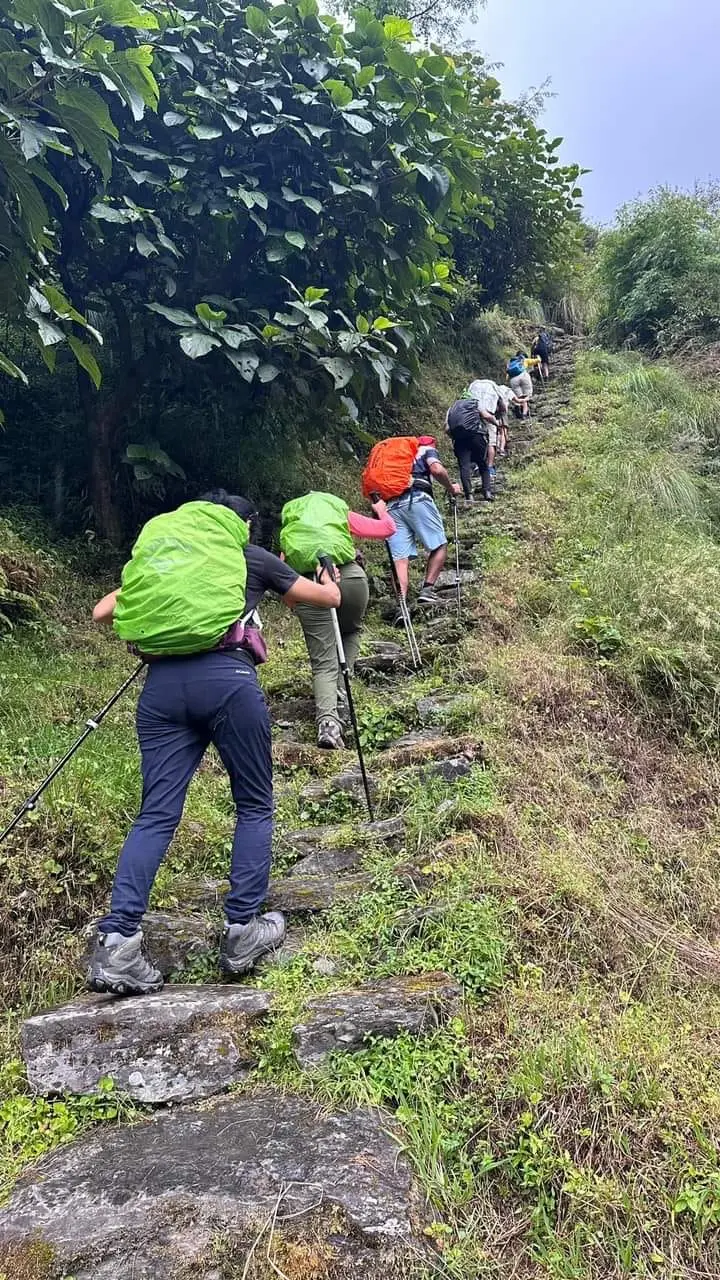
The middle section cuts through terraced potato fields where farmers greet you with "Namaste" while balancing loads on forehead straps. These high-altitude plots grow only one crop yearly due to short growing seasons. Soil erosion scars the hillsides where monsoons wash away unprotected topsoil. We instruct groups to stay on marked paths here; wandering causes irreversible damage to fragile ecosystems. Many groups complained about the "endless stairs." Our head guide demonstrated the Nepali climbing technique: step up with your whole foot, not just toes. This reduces knee strain. Proper form matters more than speed when ascending 150 meters every couple of hours. Save your energy for the final ridge where wind exposure increases.
Pine forests thin near 2,400 meters, revealing panoramic views of Hiunchuli’s ice walls. The trail flattens briefly across a plain hilltop. You’ll spot prayer flags strung between boulders marking sacred sites. Our Short Annapurna Base Camp Trek guides always pause here for oxygen checks; saturation drops 5% faster in open terrain than in forested zones. Himalaya’s cluster of stone lodges emerges unexpectedly behind a rocky scene. No gradual approach exists; the village appears only when you crest the final rise. Guesthouses use solar panels since grid electricity fails beyond this point. We have confirmed with most of the local tea houses that battery storage lasts only until 10 or 11 PM during cloudy weeks. Charge power banks before night falls or risk an empty battery.
Pack waterproof bags for camera gear today as well. The 2 PM cloud cover dumps rain even in dry season; although not a frequent phenomenon. Last monsoon's rain storm short-circuited several devices during afternoon showers. Dinner tonight features thukpa noodles with hand-rolled dumplings. The broth’s ginger and garlic content follows altitude nutrition protocols proven to improve blood oxygen levels. Trekking agencies often skip explaining why meals change at higher elevations. But, being your travel partner, we will let you know everything there is to understand about your Short Annapurna Base Camp Trek.
Sleep tonight with windows slightly open. Stale air can worsen headaches at 2,400 meters. Our guides test room ventilation during check-in; poor airflow cause sleep disruption for the majority of trekkers regardless of the season. Fresh mountain air beats warm but stuffy rooms every time. Check your water purification tablets before bed. Stream sources here might contain contaminants and germs resistant to basic filters. Two trekkers developed stomach issues after skipping this step, the last time we did this trek. Boiling remains the only guaranteed safe method above 2,400 meters, in case you run out of tablets.
Accommodation Teahouse Meals Breakfast, Lunch & Dinner Max. altitude 2,420m / 7,940ft. You're already breathing harder when the trail leaves Himalaya’s stone lodges at dawn. Granite steps replace dirt paths immediately, each rise demanding deliberate foot placement. The first hour gains 200 meters through rhododendron forests still wet with night frost. Air temperature registers 5°C at 6 AM, we will start our day 3 of the Short Annapurna Base Camp Trek at around 7. Macchapuchhre’s eastern face dominates the skyline now, its icy slopes glowing bright under morning sun. The trail runs along a ridgeline where minimal vegetation is the default, especially as we reach 3500 meters above sea level. Loose scree shifts underfoot, requiring constant micro-adjustments. Last summer, we turned back some trekkers here when two members developed headaches at 3,800 meters; acclimatization isn’t negotiable above this threshold.
But before that point, Deurali appears as a cluster of slate roofs huddled below tree lines. This critical junction sits at 3,230 meters; exactly 790 meters higher than yesterday’s endpoint. Most itineraries misstate this elevation by 200 meters, creating dangerous miscalculations. We verify heights daily using dedicated devices cross-referenced with survey markers. Teahouse owners hand out boiled potato snacks at Deurali. These starch bombs combat energy crashes during the final push. The real challenge begins after Deurali. The path narrows into a goat track switchbacking up a glacial valley. You gain 900 vertical meters in 4.2 kilometers here; steeper than any previous segment. Our Short Annapurna Base Camp Trek guides press palms gently against trekkers’ lower backs on the steepest sections.
Watch for prayer flags strung across the trail near 3,800 meters. These mark the entrance to Annapurna Sanctuary, a sacred valley surrounded by 7,000-meter peaks. The air smells sharply of pine resin and cold soil here. We have seen a couple of trekkers ending their trek at this spot due to lack of willingness to carry on forward. This is why we want our trekkers to be mentally prepared. Bamboo gives way to alpine vegetation as you near 4,000 meters above sea level. The trail cuts through frozen land where your boots crack thin ice sheets. Each step releases trapped air bubbles, a phenomenon local guides call "earth breathing."
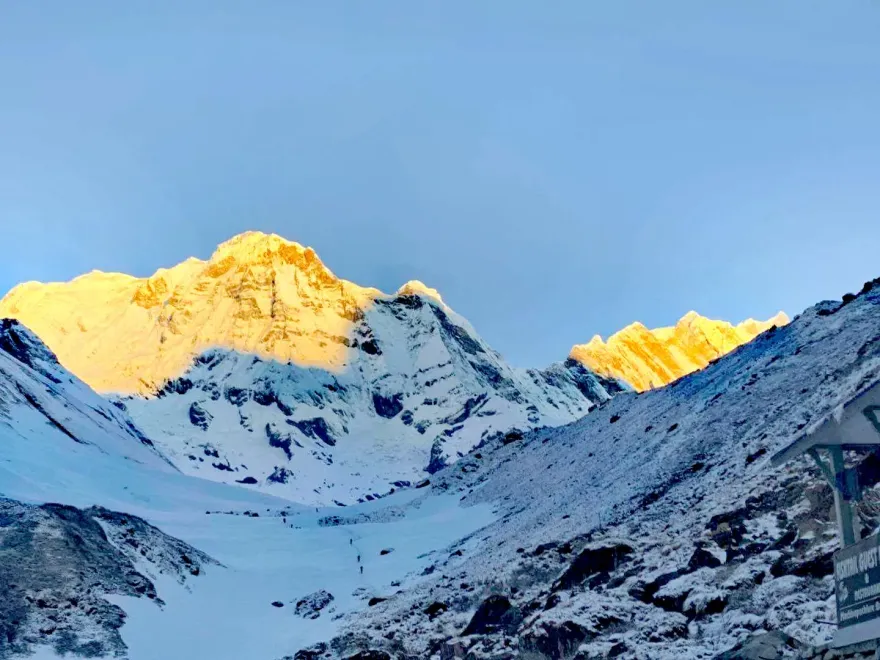
ABC comes into view without warning around a bend. No gradual reveal exists for this holy ground. The base camp sits precisely at 4,130 meters. You might taste blood in your mouth from labored breathing; a normal sign your body is working at maximum capacity. Annapurna South’s south face looms 1,500 meters above camp, its ice walls groaning like distant thunder. Sunset hits the summit at around 5 PM daily, painting the snowfields crimson for 15 to 20 minutes. We time arrivals to witness this because missing it causes heavy regret; clients consistently rank this as the Short Annapurna Base Camp Trek’s emotional peak.
Sleep tonight in communal bunkrooms with a dozen others. Body heat is critical survival here; solo tents freeze solid below -5°C. Some trekkers ignored this rule and suffered hypothermia in the past. Group warmth saves lives when temperatures plummet to -10°C by midnight. Water freezes in metal bottles by 9 PM. We boil all drinking water using wood stoves or you can just use water filtration tablets. Skip purification, and you might have to spend Day 4 vomiting.
Tomorrow’s descent requires different muscle engagement than today’s climb. Descending 1,790 meters on loose scree shreds quads if you don’t lean back slightly. Our Short Annapurna Base Camp Trek guides demonstrate the "controlled slide" technique on gravel patches. Knees protest less when you let gravity assist rather than fight it. Eat every grain of tonight’s dal bhat. Carbohydrate loading prevents muscle breakdown during long descents. You’ve earned this moment facing Annapurna’s giants. Rest fully because Day 4’s descent demands fresh legs. Our head guide will wake you at 4:30 AM to catch the first light on the peaks. Miss this, and you miss why we endure the pain; it’s not just the destination but how the mountains reshape you along the way.
Accommodation Teahouse Meals Breakfast, Lunch & Dinner Max. altitude 4,130m / 13,550ft. Early morning at ABC feels like stepping into a freezer. Frost coats every surface by 4 AM as we get ready to head out under headlamp beams. The descent begins immediately with 1,790 meters of vertical loss to Bamboo; more elevation change than any previous day but in the opposite direction. Loose scree transforms stable footing into sliding hazards. Each step requires planting your heel first to prevent ankle rolls on shifting gravel. One of our photographers ignored this technique and slid across dust and pebbles within 20 minutes of leaving camp. The Sanctuary walls narrow as you descend, creating wind tunnels that blast icy gusts across exposed sections. Temperature plummets to 4°C in these chutes despite morning sun.
Bamboo marks the critical transition from alpine to subtropical zones. This village sits precisely at 2,340 meters, not the 2,300 meters cited in outdated guidebooks. You’ll notice the sudden return of bird calls and insect sounds as rhododendron forests thicken. The air smells damp and earthy here, a stark contrast to ABC’s sterile cold. River crossings multiply near Bamboo. Many of our trekkers get used to bridges while some do not get over the fear of suspension bridges.
Teahouses at Bamboo serve black lentil soup with mustard greens. This iron-rich meal is a great food for rapid descent. The trail here follows historic trade routes used by locals and merchants of the past. You walk where yaks once hauled loads through these forests. Visible grooves in bedrock prove centuries of use. The last time we were here, the village had a grand festival.
Dinner tonight features fermented soybean curry. This protein source rebuilds muscle fibers damaged during descent. Local chefs might prepare it in clay pots over juniper fires; a method proven to retain nutrients versus boiling. Sleep early tonight as tomorrow’s final walk to Jhinu demands fresh legs after this brutal descent. Strong recovery tonight means pain-free walking tomorrow; no shortcuts exist for proper rest.
You’ve survived the mountains’ greatest test: coming down safely. Bamboo isn’t just a stop; it’s the threshold where the high country releases you. Our head Short Annapurna Base Camp Trek guide will meet you at dawn with ginger tea. The valley awaits, but the mountains have changed you. That transformation began the moment your boots hit this muddy trail.
Accommodation Teahouse Meals Breakfast, Lunch & Dinner Max. altitude 2m / 7ft. Dawn at Bamboo smells like wet pine needles and last night’s firewood. Your body recognizes flat ground immediately after four days of climbing. The 6.2 kilometer walk to Jhinu Danda takes precisely 4 hours, not because the distance is long but because your muscles rebel against horizontal movement. Rhododendron forests thicken as elevation drops to 1,200 meters. Sunlight filters through the gaps in tree branches. You notice sounds returning: woodpeckers drilling, distant cowbells, the crunch of gravel under boots. These shifts matter more than altitude now. Most trekkers even get a relief hearing a motorbike engine, it usually signals the end of the Short Annapurna Base Camp Trek.
The Modi Khola river crosses the path several times before Jhinu. Morning mist rises from its surface as you hop between moist tracks. Water temperature measures 11°C at 8 AM, a deceptive chill that numbs feet within minutes. We recommend double-layered socks throughout the trek after a couple cases of trench foot. Jhinu’s hot springs emerge shortly after. Steam rises from riverside pools maintained by local women’s cooperatives. Water temperature stays around 40°C year-round. You can try a hot bath there for as long as you like, but it's usually best to wrap up the session after an hour.
The road to Pokhara begins where the trail ends. Concrete meets dirt abruptly at a "Welcome" sign. Right now a porter adjusts his load on the roadside, he’s carried your gear for five days and vanishes with a long goodbye. Our porters usually take a different jeep back to our office. Monsoon landslides narrow the road to single-lane sections marked by recent rockfall warnings. The driver checks tire treads personally, most of the local drivers have operated this route for decades. They know every landslide scar and where the sharp bends are.
We will have a quick stop at the Landruk viewpoint. This mandatory break serves two purposes: let descending buses pass and let your body reset after road motion. The valley view reveals what trails hid, you’ve walked along that ridge, crossed that river. Pokhara’s lakeside district appears after the final turn. The smell changes to diesel and street food. Your ears pop from 800 meters of descent in two hours. Check into Lakeside Hotel by 3:30 PM. Wi-Fi reconnects instantly but feels jarring.
Lunch is simple: rice, lentils, meat, veggies, and some condiments to go along with them. Heavy meals overwhelm digestive systems after trekking. We expect all of our Short Annapurna Base Camp Trek participants to go all out tonight. Most of our trekkers breathe a sigh of relaxation after getting many food options and an actual foam mattress to sleep on. You’ll dream of mountain winds tonight. Sleep feels too quiet without river sounds.
Meals Breakfast, Lunch Max. altitude 820m / 2,690ft. 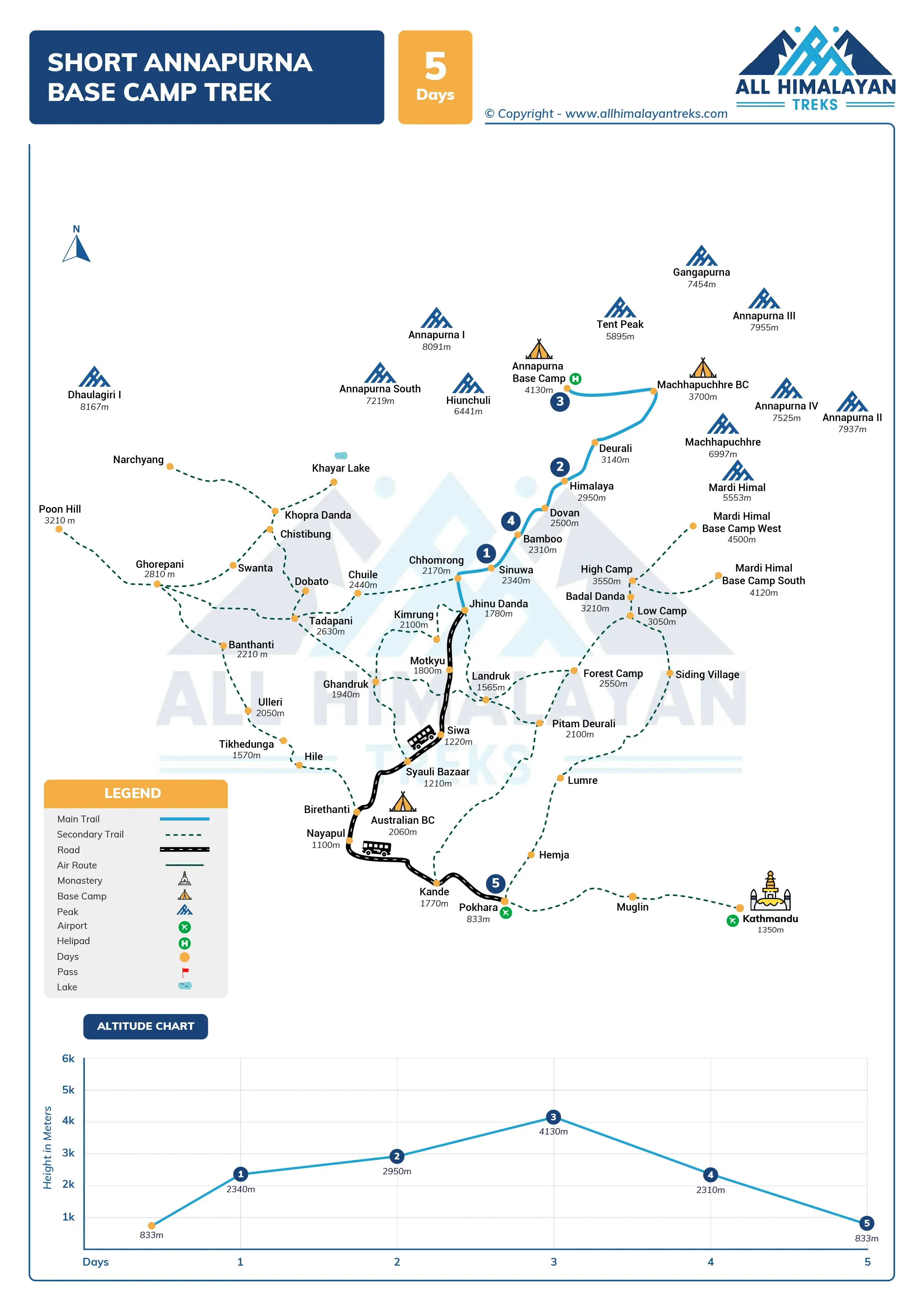
Your journey begins in Pokhara’s Lakeside area at 6 AM sharp. Skip the common Nayapul route; we drive directly to Jhinu Danda, saving 5 critical hours. The 2 hour road trip follows the Pokhara Baglung Highway through terraced rice fields where farmers harvest by hand. After we leave the highway, there are some landslide prone sites that you can see along the way. At Jhinu (1,760 meters), you step onto the trail immediately, no false starts or bus delays. The hot springs here emit 40°C steam, but we move fast, without a dip in the thermal water, before afternoon clouds roll in.
Cross the Modi Khola on a steel suspension bridge. Trail markers show 5.5 kilometers to Lower Sinuwa, but distance deceives. Elevation gain hits 580 meters through bamboo forests where humidity clings. You’ll feel calf burn within 20 minutes as stone steps demand good muscle endurance. Last season, we timed 193 meters gained hourly; deliberate pacing prevents altitude headaches. Our Short Annapurna Base Camp Trek guides do not carry spare trekking poles. All your trekking gear should be brought on your own. Pack rain gear first; afternoon showers might strike like clockwork at 2 or 3 PM.
Don’t mistake "short" for "easy." The Short Annapurna Base Camp Trek challenge hides in vertical loss and gain. Day 4’s 1,790 meter descent to Bamboo tests quads more than ABC’s climb. Loose scree throughout the trail demands constant adjustments. Every other season, you can see a couple trekkers ignoring the tips and ways of the guides only to end up cutting the trek short.
Altitude remains the silent threat. ABC sits at 4,130 meters where oxygen drops to 60% of sea level. Blood oxygen saturation falls faster during ascent than descent; a counterintuitive danger. Many trekkers push too hard coming down, which does not induce serious conditions but they might slip when in hurry. We monitor breathing rates periodically; shallow gasps at Deurali mean immediate turnaround. Trekking poles become lifelines here, reducing fall risks on 45-degree slopes.
Physical prep matters more than gear. Train with weighted downhill walks; stair machines work as well. The trail gains a couple hundred meters in 10.5 kilometers on Day 2 with gradients hitting 35 degrees. Every extra kilo multiplies knee strain exponentially on descent. On a scale of 10, our Short Annapurna Base Camp Trek guides have rated it a 6.
October delivers perfect conditions. Humidity drops after monsoons wash haze from the air. Daytime highs hit 18°C at ABC with nighttime lows of -5°C; ideal for steady pacing. Visibility stretches extensively, offering a wide panoramic view of the entire Annapurna range. Sunset at ABC lasts around 20 minutes when Annapurna South glows crimson; we time arrivals precisely for this. Trails stay dry until noon as glacier melt hasn’t accelerated yet. Avoid November’s trap; daytime warmth (20°C) tempts trekkers to shed layers, but nighttime plunges to -10°C by Day 3. March offers the second-best window. Rhododendrons bloom crimson at 2,500 meters, but snow lingers on ABC’s approach.
Monsoon (June-September) brings 400mm monthly rainfall. Landslides sometimes block the Jhinu road; in the last 2 years it has been closed for almost a week. Trails become leech corridors near Bamboo where humidity hits high. But shoulder seasons have a few perks, December’s clear skies reveal Annapurna’s ice walls. Just expect -15°C at ABC and frozen water sources.
Beginners face significant hurdles on this route. The Short Annapurna Base Camp Trek demands 5 consecutive days of 4–7 hour walks with steep ascents and descents. You must handle a couple hundred meters of steep elevation gains on Day 2 through loose scree where one misstep risks serious injury. As per our expertise, the majority of untrained beginners fail to reach ABC due to weak quads, not poor cardio. Train specifically with weighted downhill hikes for 8 weeks minimum; stair machines do the work too, just prepare your knees for 45-degree slopes.
Altitude exposure separates capable beginners from those who turn back. ABC sits at 4,130 meters where atmospheric pressure drops to 60% of sea level. We require proof of prior 3,000+ meter experience; last time three beginners developed signs of altitude sickness near Deurali because they skipped acclimatization days. No agency should accept clients without documented high-altitude hikes.
Physical thresholds are non-negotiable. Carry only 5 kg including water, every extra kilo multiplies knee strain exponentially on descent. Our Short Annapurna Base Camp Trek porters only carry your luggage, not your day pack. If you can’t walk 15 kilometers with 5 kg on steep terrain before arriving, postpone your trip. This isn’t a casual hike, it demands mountain-specific conditioning.
AMS (Acute Mountain Sickness) hits faster than beginners expect. Symptoms appear above 3,500 meters where oxygen drops noticeably. You’ll notice headaches and nausea first, not weakness. We enforce mandatory oxygen checks at Deurali (3,230 meters); saturation below 85% means immediate descent, no exceptions. Prevention beats treatment is the way to go. Sleep at lower elevations than daily max, ABC’s 4,130 meters requires prior nights at 2,900 and 3,230 meters. Skip this, and your risk of altitude sickness increases. Drink 3 liters daily but avoid overhydration; electrolyte imbalance worsens symptoms. Our guides carry pulse oximeters, not just altitude pills. Some trekkers do not agree to descent even when their oxygen level is low, which causes them to suffer more. Portable oxygen canisters help but don’t replace descent.
Teahouses operate on basic infrastructure. At ABC (4,130 meters), expect shared dormitories with multiple people per room. No private rooms exist beyond Deurali. Solar power sometimes fails after cloudy days; charge devices whenever you get the chance to or go dark. Bamboo’s teahouses use wood or kerosene stoves for boiling water, a necessity since LPG is expensive above 4,000 meters.
Food safety drives menu choices. Stick to dal bhat (lentil soup with rice) and thukpa noodles, these use boiled water and kill pathogens. Avoid salads and raw vegetables; most of our trekkers seem to develop a lasting love for traditional Nepalese dishes.
Water discipline saves lives. Never drink untreated stream water even if clear. At ABC, water freezes by 9 PM, store bottles upside down so ice forms at the top, leaving liquid below. A couple of the past groups ignored this and woke to solid blocks. Drink 3 liters daily but stop 2 hours before bed; bathroom runs at -10°C is not very practical.
Your Short Annapurna Base Camp Trek starts with a 2-hour drive from Pokhara to Jhinu Danda in a reinforced jeep. This isn’t standard tourism transport, it’s a monsoon-tested vehicle with 4x4 capability and reinforced undercarriage for landslide-prone sections. Drivers like ours inspect tire treads personally before departure; he has been on this trail for years. The road narrows to 4 to 5 meters after Landruk village, too tight for two vehicles. Our drivers follow a strict route with no diversions. We have never run into any transport issues throughout any point on the trek. At Jhinu, the transition from road to trail happens within 5 minutes, no waiting for porters. We’ve timed this shift to beat 2 PM cloud cover that often brings in rain.
Return transport uses the same jeeps but demands different protocols. After the trek, drivers check suspension systems for stress fractures from mountain roads. Seatbelts are non-negotiable through single-lane cliff sections where guardrails are absent. Landruk viewpoint serves as a mandatory 15-minute stop: let the other vehicles pass and reset your body after a long time of sitting.
You need two verifications: the Annapurna Conservation Area Permit (ACAP) and the Trekkers’ Information Management System (TIMS) card. ACAP costs 3,000 NPR (around $22) for foreigners and requires passport-sized photos. TIMS costs 2,000 NPR (around $15) and mandates proof of travel insurance covering 5,000+ meters above sea level. Verification happens at 3 checkpoints: Birethanti (1,020 m), Chhomrong (2,170 m), and Deurali (3,230 m). Rangers validate the permits before letting us continue the Short Annapurna Base Camp Trek forward. Some trekkers might have issues with mis spelled names, so always make sure it's correct before you begin the trek. We submit all client documents 5 days pre-departure; processing takes a couple of business days. Personally, we have not faced this issue yet, but it is a possibility.
Forget generic "train for weeks" advice; specificity saves knees. You need 8 weeks of slope conditioning: 45-minute sessions, 4x weekly, on a 15-degree decline treadmill. This reduces strain on Day 2’s scree slopes and the main climb to the base camp. We enforce pre-departure weigh-ins; last month three clients removed 1.3 kg of non-essentials. Train with your actual boots: break them in for the Short Annapurna Base Camp Trek trail to prevent blisters.
Skip the standard Modi Khola path if monsoons threaten. The Ghorepani-Poon Hill detour adds 27 kilometers but avoids landslide zones where the main road closed a couple of days last July. This route gains 1,200 meters to Poon Hill’s summit (3,210m) before cutting west to Sinuwa. You’ll trade river fords for stone staircases through rhododendron forests; less slippery when wet but demanding more knee flex per step according to our experienced guides. Moreover, you can also add nearby destinations to our standard Short Annapurna Base Camp Trek if you prefer so. Just make sure to run it by one of our reps so we can work out the logistics and final pricing of the trek package.
ACAP costs 3,000 NPR (about $22), TIMS 2,000 NPR (approx. $15), and Pokhara-Jhinu transport 1,500 NPR ($11) per person. All of these expenses will be covered by the Short Annapurna Base Camp Trek. Teahouse costs escalate with altitude: Jhinu dorms charge 300 NPR nightly while ABC rooms hit 800 NPR. Meals follow similar patterns, dal bhat costs 600 NPR at Bamboo but 950 NPR at Himalaya. Gear rentals are at your own expense. Trekking poles cost 300 NPR daily but damage fees hit 1,500 NPR for snapped tips. The same can be said for emergency evacuation procedures, if you happen to need it at any point on the Short Annapurna Base Camp Trek.
Solar charging is the most reliable above 3,000 meters. At ABC (4,130m), a 20,000mAh power bank recharges your daily gadgets on the go and during the night time when solar power is usually shut down. Teahouse electricity follows strict schedules to save precious and limited energy supply. Two weeks ago some trekkers missed their photo opportunity as they forgot to charge their camera battery on time. 4G coverage exists only below 2,000 meters. Nepal Telecom’s 2025 coverage map shows zero signal at ABC and patchy service above Deurali. Download offline maps before leaving Pokhara; although our Short Annapurna Base Camp Trek guide will make sure that you are on the right track, it's good to know where you are at any given time.
Nepal visa costs $30 for 30-day multiple entry, paid in USD cash at Tribhuvan Airport. We verify your passport has 6+ months validity pre-departure; expired documents have caused us some trouble in the past. Pokhara meals drain budgets silently. Lunch at Lakeside restaurants averages $5–$10 per person for dal bhat with meat options. Our guides know the best local places to eat, on a budget too. You can ask for recommendations if you would like to try some.
Tips follow unspoken rules. Guides expect 800–1,000 NPR daily; porters 500–700 NPR. Emergency costs operate on brutal math. Stretcher evacuation from Deurali costs 2 to 3K NPR per hour; doubling after dark. We also mandate travel/medical insurance. Without insurance we will not proceed with the Short Annapurna Base Camp Trek. Last season, a trekker on some other group skipped insurance, his helicopter evacuation cost $5,000 paid out-of-pocket. No agency covers this; your policy must name "altitude above 4,000m" explicitly.
Insurance isn’t optional, it’s survival math. Policies must cover at least $10,000 medical evacuation and helicopter rescue up to 5,500 meters. We verify policy wording pre-departure: "high-altitude trekking" must appear. We have seen a trekker's insurer reject a $8,500 bill because his plan said "hiking" not "trekking." While our Short Annapurna Base Camp Trek covers most of the daily expenses throughout the trek, it is simply impractical to cover all the expenses incurred. So, there are some expenses that you have to pay for separately.
Jhinu Danda sits at a higher elevation than Nayapul. In addition to that, going directly to Jhinu Danda enables us to skip the 11 km trek to Ulleri village.
Yes, that is a possibility, but you need to give us at least a couple of business days to prepare things for the new trekker.
On average you will have to walk 5 to 6 hours per day. This is standard for most mountain trekking destinations.
Yes, most of the teahouses prepare garlic soup among other types of soups. Garlic soups are not mandatory, but we do recommend you try it at least once.
The higher we climb, the availability of private rooms goes low. The base camp is the highest point of the Short Annapurna Base Camp Trek and getting private rooms there is basically impossible.
Solar power is highly reliable, most of the houses and teahouses in Himalaya depend on it for their daily chores. You can rest assured that your time in Himalaya will be well facilitated.
No, the teahouses can not accommodate dietary restrictions without prior notice. The high hills do not have plenty of resources, so preparing food is always based on pre-arranged instructions.
At around 8 pm, the kitchen usually stops serving meals. However the dining halls stay open till 10 pm, where trekkers gather to converse and find new trek buddies.
You can simply go on downhill walks or use the stair master machine at your gym. Getting used to the strain and building your leg muscles helps a lot in the Short Annapurna Base Camp Trek.
Your day pack should not weigh more than 5 kg at any point during the trek. There is no need for you to over exert yourself, carrying unnecessary weight.
Microspikes are not necessary near Deurali in April, but if it makes you more confident and comfortable, you can wear them.
For this 5-day long trek, we recommend at least 7 pairs, just to be on the safe side. The chances of getting your socks wet is low, since you will be wearing rain gear, nevertheless it's better to stay safe.
If your blood oxygen level drops below 85% at any given time throughout the Short Annapurna Base Camp Trek, we will have you descend until it's back to normal.
Yes, regardless of the proficiency and experience level of our trekking groups, we mandate our guides to carry oxygen canisters. Safety comes above everything else.
It's not exactly about symptoms, rather the condition of trekkers. Some trekkers are physically unable to walk down to lose elevations, while some seem energetic even when symptoms are seen.
There are no specific models that we use. However, we make sure that the vehicle is 4WD.
The Prithvi Highway rarely closes due to monsoon conditions. However, the chances are not absolute zero.
We must board the jeep after we have enjoyed a relaxing bath at the hot springs. Usually, we board the jeep by 3 pm, but there is no hurry.
Yes, every vehicle we provide has seat belts. It is very important to tuck yourself in on rugged mountain roads with sharp turns.
At the end of the Short Annapurna Base Camp Trek, it will take us about 2 hours to get to Pokhara from Jhinu Danda.
You just have to provide your passport and a couple of passport sized photos. Our guide will handle filling out the forms on your behalf.
You do not have to pay for evacuation if you have insurance. This is exactly why we mandate every trekker to have medical or travel insurance before we start trekking.
As soon as you start the trek, your credit cards are basically useless. Cash is the only preferred means of payment throughout the Short Annapurna Base Camp Trek.
If you happen to lose your permits at any point throughout the trek, you will have to pay a fine and get a new one.
There are no toilet fees in the mountains, you can use the shared toilets at teahouses free of charge. However, you have to bring your own toilet paper.
Personally, our lead guides have over a decade of experience on this particular trail.
Every two trekkers in the group will share a single porter who will carry a maximum of 25 kg.
Yes, our guides are well equipped when it comes to safety and necessary equipment.
We require a 50% advance payment to be able to book this Short Annapurna Base Camp Trek.
We require trekkers to complete the payment at least 3 weeks before the trek starts.
Yes, we do accept USD cash payments.
There is no exact number for this, but you can expect the majority of the days to be clear.
Autumn and spring are the best choices for clearest views. Summer is also a viable option.
The average temperature at ABC hovers around 5 to 15 degrees Celsius.