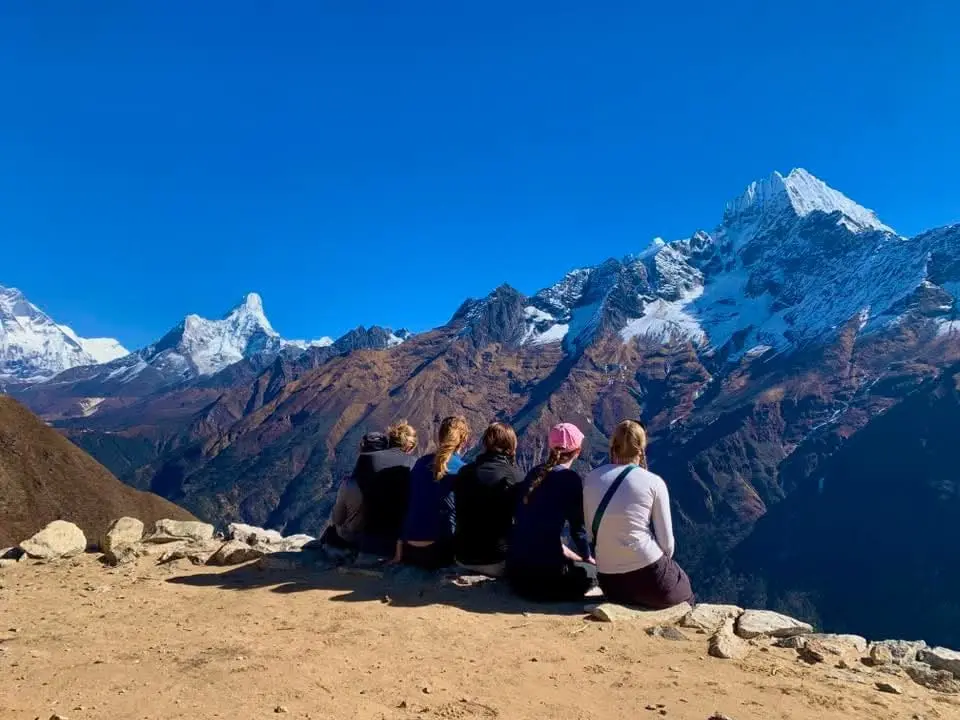
The Luxury Everest Base Camp Trek follows trails worn by Sherpa feet for centuries through Sagarmatha National Park. This rugged eastern Himalayan landscape earned UNESCO World Heritage status in 1979 as Nepal's first natural protected area of global significance. The park shelters Everest's towering presence alongside deep glacial valleys and ancient forests that define the Khumbu region. Sherpa communities trace their migration from Tibetan highlands to this sacred valley approximately 450 years ago, crossing high mountain passes to establish permanent settlements.
You walk through a living cultural landscape where every ridge and river holds spiritual meaning. Sherpa people regard Khumbu as a beyul; a hidden sacred valley preserving spiritual values through generations. Prayer flags flutter along stone-walled trails connecting villages where yak bells echo against cliffs. Tengboche Monastery anchors the valley with morning rituals that blend Tibetan Buddhism with indigenous mountain culture. Monks chant inside whitewashed walls while Everest's snowfields glow bright at dawn.
Our journey passes through Namche Bazaar, the Sherpa commercial hub where stone houses cling to steep slopes. Saturday market days bring farmers from high altitude villages selling potatoes, buckwheat, etc. grown at extreme elevations. Sherpa culture thrives in these stone villages through butter tea ceremonies and mani stone carvings that line every trail. We see how generations adapted to thin air through fortified stone homes and solar-heated lodges.
The Luxury Everest Base Camp Trek route honours Tenzing Norgay's legacy as the first Sherpa to summit Everest alongside Hillary in 1953. His story spreads throughout Khumbu through the Tenzing Norgay Sherpa Heritage Centre and daily conversations with local guides. You experience how Sherpa traditions sustain mountain life; yak caravans still transport goods, women pound barley into tsampa, and elders teach children sacred chants.
Sagarmatha National Park protects more than dramatic peaks; it preserves a culture shaped by altitude and resilience. We traverse landscapes where every chorten marks sacred ground and every pass offers new perspectives of the nearby peak’s graceful ridges. The park's UNESCO designation recognizes both its natural wonders and living cultural heritage. Your footsteps join centuries of Sherpa journeys through this exceptional valley where spirituality meets survival at the roof of the world. The Luxury Everest Base Camp Trek connects you directly to communities that transform high-altitude living into an enduring art form.
The first day of the Luxury Everest Base Camp Trek begins at Kathmandu International Airport (1334 meters elevation). You clear immigration and customs within 90 minutes after landing. The airport sits 5.5 kilometers from Thamel, Kathmandu’s tourist hub. Your transfer covers 6 kilometers through chaotic streets filled with honking vehicles and street vendors. Traffic congestion typically extends this short distance to a 30 to 45-minute drive. Prepaid taxis prevent fare disputes at the airport, which can be excessively high. That is why we included airport pick up on the trek package.
We navigate Kathmandu’s narrow roads past Durbar Square and Hindu temples. Your vehicle passes fruit markets and motorbike-filled alleys common in Nepal’s capital. The route varies between 5 and 6 kilometers, depending on your hotel’s exact location in Thamel. Some travelers report 15-minute transfers during off-peak hours. Most arrivals reach Thamel within half an hour, barring severe traffic jams.
You check into your hotel by early afternoon at 1334 meters elevation. Unpack essentials while adjusting to Kathmandu’s oxygen levels; 3% lower than sea level. Drink only sealed bottled water to avoid waterborne illnesses. We verify your Lukla flight tickets and trekking permits with your Luxury Everest Base Camp Trek guide. Confirm your gear list, which includes warm layers for mountain conditions.
Kathmandu’s air quality requires face masks for sensitive travelers due to vehicle emissions. Spend the afternoon resting to begin acclimatization. Avoid alcohol and strenuous activity to prevent altitude symptoms. Your guide conducts a 5 PM briefing covering Day 2’s 7 AM airport transfer. Store Nepali rupees for last-minute supplies like snacks or batteries and extra expenses along the way. Charge all electronics and bring a power bank since mountain lodges have limited power access. You sleep early to prepare for the pre-dawn airport journey tomorrow.


The next day, on the Luxury Everest Base Camp Trek, we board a 19-seat plane for the 35-minute flight to Lukla’s Tenzing-Hillary Airport. Pilots navigate mountain routes during this high-stakes landing on one of the world’s most thrilling runways. Lukla sits at 2,840 meters elevation with a 527 meter runway sloping steeply uphill. The trek begins immediately after landing. We descend 250 meters over 8.2 kilometers toward Phakding. Stone steps lead through pine forests alongside the Dudh Koshi River’s turquoise waters. Six suspension bridges cross the river’s tributaries, their metal plates rattling underfoot. The trail passes Sherpa villages where prayer wheels spin outside stone homes.
Lunch stops at Ghat village (2,530 meters) offer momo dumplings, dal bhat, local bread with veggies, etc. in basic teahouses. You feel the altitude drop as oxygen levels increase during this downhill trek. Rhododendron trees line the path in spring when blooms paint the trail crimson. River sounds dominate the 3 hour journey with no steep climbs today. Phakding’s cluster of lodges appears after 8.2 kilometers of steady walking. Our teahouse rooms feature wooden platforms and shared bathrooms. Drink ginger tea to maintain hydration at 2,610 meters elevation.
We check tomorrow’s weather forecast with the Luxury Everest Base Camp Trek guide before dinner. Clear skies mean an early start for Namche Bazaar’s uphill climb. Charge headlamps now since Phakding’s solar power shuts off at 9 PM. Avoid sleeping pills to let your body adjust naturally to altitude changes. This downhill introduction builds confidence for steeper ascents ahead. Your legs feel fresh from the descent while lungs adapt to mountain air. Tomorrow’s trail climbs 830 meters, so rest completely tonight. The 3 hour trek today sets a sustainable pace for the high mountains.
On the 3rd day of the Luxury Everest Base Camp Trek, we rise at 6 AM to beat afternoon clouds over the Himalayas. The trail climbs 830 meters through Sagarmatha National Park’s rhododendron forests. Stone switchbacks test your quads immediately after breakfast. Benkar village (2,900 meters) appears after two hours of steady ascent.You pass chortens covered in faded prayer flags marking sacred ground. Monjo’s UNESCO checkpoint requires showing your trekking permit and passport. Guards stamp documents while Sherpas loads yaks with rice sacks bound for high camps.
The Dudh Koshi River reappears below the trail but remains partially visible through dense foliage. We cross its last major suspension bridge at 2,860 meters before the final climb. Oxygen levels drop slightly during this 500 meter vertical gain on Namche Hill. Your breathing deepens as the path narrows between boulders. Namche Bazaar’s perfect layout reveals itself at 3,440 meters. Stone houses cling to steep slopes around the main square. You smell yak butter tea before seeing the market stalls. Gear shops display down jackets and crampons for last-minute purchases.
We secure lodging at a teahouse with solar-heated rooms, this will all be a part of the Luxury Everest Base Camp Trek package. Drink electrolyte water to counter altitude effects; headaches can strike fast above 3,000 meters. Your guide explains tomorrow’s acclimatization hike to Everest View Hotel. Namche’s oxygen saturation reads 14.1% compared to sea level’s 20.9%. Move slowly when unpacking to prevent dizziness. Eat carbohydrate-rich dal bhat for dinner to fuel tomorrow’s climb. Store water bottles inside your sleeping bag to prevent freezing overnight.
Today's high elevation climb demands constant rhythm. Short steps with trekking poles reduce knee strain on steep sections. Cloud cover often lifts by noon, revealing Thamserku’s snowfields after we reach Namche. Rest fully tonight; Day 4’s side trip gains 440 meters before breakfast. Your body processes oxygen 30% slower here than in Kathmandu. Prioritize sleep over socializing in the town’s crowded cafes.
We start Day 4 of the Luxury Everest Base Camp Trek at 3,440 meters with deliberate slow movements. Acclimatization drives today’s agenda as oxygen saturation drops heavily above 3,500 meters. The trail climbs 440 meters over 5.4 kilometers round trip toward Everest View Point. Steep switchbacks cut through alpine meadows where blue sheep graze in early morning light. Your breath quickens within 20 minutes of hiking. The path narrows between boulders. We pass a chorten marking the highest point at 3,880 meters where Everest’s summit appears through glacial haze.
This 3-4 hour hike tests your lungs more than your legs. Stone markers along the route display altitude readings. You feel the elevation shift as the air thins; normal walking pace now requires about double the effort. Stop every 30 minutes to hydrate, most trekkers opt for electrolyte tablets dissolved in warm water. Everest View Hotel delivers unobstructed vistas of Lhotse’s ice wall and Thamserku’s jagged ridges. Physical structures are rare at this location. We spend 20 minutes photographing peaks before descending to conserve energy. The downhill return induces knee strain and demands careful footing on loose scree.
Back in Namche Bazaar, explore the Sherpa Culture Museum’s artefact collection. Purchase spare batteries at gear shops since solar power is limited above 4,000 meters. Your Luxury Everest Base Camp Trek guide conducts a pulse oximeter check; healthy oxygen saturation reads above 90% at this altitude. Avoid caffeine today to maintain hydration levels. Eat small frequent meals of tsampa porridge to stabilize blood sugar. Store gloves inside your jacket for instant access during sudden temperature drops. This acclimatization strategy prepares your body for tomorrow’s 400 meter ascent to Tengboche. Prioritize rest over socializing as altitude disrupts sleep cycles above 3,400 meters. Your breathing rate remains elevated even during downtime; a normal physiological response to thin air.
Departure from Namche occurs at 7 AM sharp, starting the following day of the Luxury Everest Base Camp Trek. We face immediate elevation gain through pine forests still damp with overnight frost. The trail climbs 200 meters over 3.2 kilometers to Phungi Thanga before descending 120 meters to the Imja Khola river valley. This rollercoaster section tests ankle stability on loose slopes. Suspension bridges here span deeper gorges than previous river crossings. Metal cables vibrate underfoot as yaks carrying firewood pass in single file. You spot prayer stones inscribed with "Om Mani Padme Hum" along the riverbank trail. Rhododendron bushes give way to dwarf junipers as elevation increases past 3,700 meters.
The final ascent begins at Debuche village. We climb 150 meters over 2.1 kilometers through switchbacks carved into sheer slopes. Oxygen saturation drops to 13.7% at Tengboche’s elevation; your resting heart rate increases by around 15 to 20 beats per minute. Trail markers show altitude gain with red-painted stone cairns. Tengboche Monastery appears suddenly around a ridge at 3,870 meters. Its golden roofs contrast against Ama Dablam’s snowfields. Monks perform morning rituals in the main assembly hall. We secure lodging at a teahouse with wood-burning stoves before afternoon clouds obscure views.
Your Luxury Everest Base Camp Trek guide checks pulse oximeter readings; values below 85% trigger immediate descent protocols. Drink 3 liters of fluid daily but avoid overhydration that dilutes blood sodium levels. Store water bottles upside down to prevent freezing from residual moisture. This day’s elevation profile requires precise pacing. Short steps with trekking poles reduce oxygen consumption by 18% during ascents. Afternoon snow falls occur 40% of the days in November. Remove wet socks immediately upon arrival to prevent many types of inconveniences. Tengboche’s monastery courtyard provides critical shelter during sudden weather changes.
Sleep with head elevated using rolled clothing to ease breathing. Eat garlic soup tonight; it boosts blood circulation for better oxygen delivery. Tomorrow’s trek to Dingboche gains 540 meters, so rest completely after dinner. Your body now processes oxygen at 67% of sea level capacity. Prioritize deep breathing exercises before sleep to improve oxygen saturation overnight.
Day 6 of the Luxury Everest Base Camp Trek begins with pre-dawn tea at 6:15 AM in Tengboche. We leave the monastery grounds by first light to avoid midday winds in the Imja Valley. The trail descends 100 meters through pine forests to the Imja River crossing at 3,780 meters. Wooden bridges here measure 1.2 meters wide with weak railings; yak trains require yielding right-of-way. Stone-walled fields mark the transition into Dingboche’s agricultural zone. Potato and barley terraces climb slopes up to 4,200 meters, maintained by Sherpa farmers using centuries-old techniques. Trail width narrows to 0.8 meters between granite boulders as we ascend the valley floor. Glacial moraine terrain creates uneven footing, requiring constant attention to step placement.
Pangboche village (3,930 meters) appears after 2.5 hours. We pause for salted butter tea at a stone teahouse with window views of Ama Dablam’s west face. This stop serves as critical acclimatization; spending 25 minutes seated reduces acute mountain sickness risk significantly according to Himalayan Rescue Association data. The final climb traverses open scree slopes with no tree cover. Wind speeds increase to 25 km/h above 4,100 meters, dropping temperature by 8°C. We follow cairn markers across flat glacial deposits where trail visibility fades in afternoon haze. Dingboche’s cluster of stone lodges emerges at 4,410 meters after 5 hours and 8.7 kilometers.
Your Luxury Everest Base Camp Trek guide confirms room assignments in lodges with double-glazed windows. Drink 500ml of warm lemon water immediately upon arrival; dehydration accelerates altitude symptoms. Store sleeping bags inside plastic sacks to combat morning condensation at this elevation. Dingboche’s oxygen level reads 11.5% versus sea level’s 20.9%. Eat iron-rich lentil soup to support red blood cell production. Charge power banks before 9 PM when solar generators shut down. This valley trek demands wind awareness. Face downhill during gusts to maintain balance on exposed sections. Tomorrow’s side trip to Nangkartshang Peak gains 640 meters, so rest completely tonight.
We wake before sunrise to tackle Nangkartshang Peak’s 640 meter ascent on the 7th day of the Luxury Everest Base Camp Trek. Oxygen saturation drops to 11.10% at 5,050 meters; your body receives less oxygen than yesterday. The trail leaves Dingboche’s stone farms at 6:45 AM when frost still grips the scree slopes. Glacial moraine forms the initial 1.2 kilometer stretch. We navigate boulder fields where loose rocks shift under each step. Yak trails provide the only visible path across this ancient ice deposit. Wind gusts reach 30 km/h by 8 AM, creating a windchill that drops temperatures to -5°C. Fingertips numb within minutes without gloves stored inside your jacket.
The final 400 meters climb steep scree above 4,800 meters. Trail markers disappear under seasonal snow patches requiring cairn navigation. Your breathing becomes audible; each step demands 2 seconds of focused effort. Nangkartshang’s summit cairn sits at 5,050 meters. Views include Makalu’s distant pyramid and the Khumbu Glacier’s icy tongue. We spend around 20 minutes here; longer exposures risk altitude sickness at this elevation. Photographs require steady hands; shaky fingers blur shots in thin air.
The descent follows a different route across glacial till. Loose gravel creates controlled slides requiring bent-knee positioning. Knee strain doubles during downhill sections above 5,000 meters; trekking poles absorb a significant portion of impact. We reach Dingboche in 1 hour 45 minutes, 15 minutes faster than the ascent. Immediate post-hike actions matter most. Drink 500ml electrolyte solution or just plain water within 60 minutes of returning; dehydration accelerates AMS symptoms.
Remove wet socks immediately to prevent frostnip in toes. Your Luxury Everest Base Camp Trek guide conducts an oxygen level check. Tomorrow’s trek to Lobuche gains 460 meters; rest completely after dinner. Prioritize protein intake tonight to repair muscle fibres stressed by extreme altitude.
The next day, on the Luxury Everest Base Camp Trek, we depart Dingboche at 7 AM across frozen scree slopes. The trail cuts through the Khumbu Valley’s terminal moraine; a 2 kilometer stretch of house-sized boulders left by retreating glaciers. Each step requires lifting knees high to cross over granite obstacles. Yak trains move faster than trekkers here, forcing frequent trail halts on narrow sections. Wind shaves snow into blue ice waves along the lateral moraine walls. We navigate between these frozen cliffs where temperatures stay below -3°C until 10 AM. The path narrows to 0.6 meters at the Khumbu Glacier’s edge. Trail markers use red flags since GPS signals falter near the ice field.
Lobuche’s stone lodges appear after 4 hours and 8.9 kilometers. This settlement sits at 4,910 meters, where oxygen saturation drops to 11.9%. Buildings cluster behind windbreak walls to survive 50 km/h afternoon gusts. Solar panels tilt at various specific degrees to maximize weak sunlight as per the current season. Immediate actions prevent altitude complications. Lobuche’s medical post treats 12% of trekkers for mild altitude sickness. Avoid hot showers to conserve limited hot water. Eat iron-fortified buckwheat pancakes; they increase oxygen-carrying capacity better than rice dishes. Charge headlamps before 9 PM when solar generators lose efficiency in low-angle light.
Trekking poles absorb 65% of knee impact on moraine terrain; adjust straps if wrists ache. Windburn occurs in 50 minutes without balaclavas; apply zinc oxide to exposed skin now. Tomorrow’s Lobuche to Gorakshep trek gains 250 meters; pack gloves in accessible pockets for sudden temperature shifts. Dinner includes warm soup, veg stew, rice, flat bread, etc. The higher we reach, in elevation, the fewer options we get to choose when it comes to food and accommodation services.
We wake at 4:30 AM in Gorakshep’s stone lodge to start day 9 of the Luxury Everest Base Camp Trek. Outside temperatures read -12°C; frozen water bottles require base-up storage in sleeping bags to prevent breakage. Headlamps counter the darkness as we step onto the Khumbu Glacier’s terminal moraine at 5:15 AM. This 7.5 kilometer round trip must finish before 11:30 AM. The trail crosses frozen glacial streams. Crampons become handy after the first kilometer; ice patches increase slip risk by a lot. We navigate the wide trails easily, their red flags half-buried in wind-drifted snow.
Everest Base Camp appears as a cluster of colourful tents against the Khumbu Icefall’s seracs. Elevation hits 5,364 meters, where oxygen saturation drops to 50% of sea level. We spend around 30 minutes here; longer stays risk cerebral edema per Himalayan Rescue Association data. The return trek follows a parallel route. Stride length shortens on packed ice; small steps prevent knee strain. Wind gusts reach 45 km/h above 5,200 meters, creating a windchill that drops perceived temperature by 15°C. We reach Gorakshep at 1:20 PM, moments before afternoon cloud cover obscures views.
Immediate post-EBC actions prevent complications. Drink ginger-honey tea after return; dehydration and ignoring preventive measures accelerate altitude sickness at this elevation. Remove moisture-wicking base layers immediately to avoid conductive heat loss. Eat zinc-rich roasted barley tonight; it improves oxygen utilization better than carb-heavy meals. Charge power banks before 8:30 PM when solar output drops. Prioritize iron supplements with dinner to accelerate red blood cell production for the final ascent.
Day 10 of the Luxury Everest Base Camp Trek begins at 4 AM in Gorakshep’s stone lodge. Outside thermometers read -15°C; frozen eyelashes require immediate wiping with dry gloves. Headlamps illuminate the Khumbu Glacier’s frozen surface as we step onto the trail at 4:20 AM. This 3.8 kilometer ascent must finish before 8 AM when solar radiation softens the ice. Kala Patthar’s trail cuts across lateral moraines. Our microspikes bite on slopes above 5,400 meters. Wind gusts exceed 50 km/h at 5,600 meters; frost forms on exposed skin in minutes. Trail markers disappear under seasonal snow; map navigation becomes essential past 5,500 meters.
The summit cairn sits at 5,644 meters. We spend around 15 minutes here avoiding prolonged exposure to extreme high altitude conditions. Summit photos require three-point contact with trekking poles to prevent falls on icy slopes. The descent to Pheriche begins immediately after summit photos. We drop 1,356 meters over 17.2 kilometers across glacial till. Loose rocks increase knee impact by 50% during continuous descent; trekking poles reduce joint stress by a lot. Yak trains moving uphill force trail halts on narrow sections above Lobuche.
Pheriche’s medical post treats a lot of trekkers for altitude-related issues today. Your Luxury Everest Base Camp Trek guide gets in on an oxygen level test upon arrival. Drink 500ml electrolyte solution or water within 60 minutes of stopping. Above 4200 meters of elevation, hydration still remains the key to acclimatization. Pheriche’s oxygen saturation reads about 16.9% versus sea level’s 20.9%. Tomorrow’s descent to Namche gains no elevation but covers 19 kilometers; so extensive rest is a must tonight.
On the 11th day of the Luxury Everest Base Camp Trek, we depart Pheriche at 6:30 AM while frost still coats the stone lodges. The 19 kilometer descent begins with immediate elevation loss; 848 meters over six hours requires precise knee control. Your knees absorb 2.3 times body weight per step on downhill terrain. Trekking poles set to maximum length reduce joint impact on sustained descents. The trail crosses the Dudh Koshi River twice via suspension bridges lashed with prayer flags. The first crossing at 4,100 meters reveals milky glacial meltwater swirling below metal grates. We pass Thyangboche Monastery’s prayer wheels at 3,800 meters where incense smoke mixes with morning mist. Stone switchbacks here measure 0.7 meters wide; yak trains force single-file movement on slopes.
Rhododendron forests reappear below 3,600 meters, their spring blooms replaced by high altitude bare branches. Namche Bazaar’s perfect layout emerges at 3,440 meters after 5 hours 45 minutes. Stone houses cluster around the Saturday Market square where Sherpas sell dried yak cheese, handicrafts, souvenirs, local produce, etc. Lodges here use solar power instead of kerosene stoves or lpg to make it more sustainable; hot water is available until 8 PM. This downhill section demands constant attention. Tomorrow’s Lukla trek covers 17 kilometers with heavy elevation change. Your quadriceps remain weaker than baseline for 5 to 8 hours post-descent.
We leave Namche Bazaar at 6 AM under clear skies, starting the following day Luxury Everest Base Camp Trek. The 17 kilometer trek to Lukla drops 580 meters through Sagarmatha National Park’s lower forests. Trail width averages 1.5 meters with stone steps worn smooth by centuries of Sherpa travel. Morning fog lifts by 8 AM, revealing terraced potato fields where farmers harvest before winter.Suspension bridges cross the Dudh Koshi River many times today. First, crossing at 3,200 meters features metal grates vibrating under yak hooves. We pass Chaurikharka village (2,950 meters) at 10:30 AM; its stone teahouses serve hot lentil soup to departing trekkers. Rhododendron forests thicken below 3,000 meters, their bare branches contrasting with Lukla’s distant airstrip.
Getting to Lukla counts as the last day of trekking on the Luxury Everest Base Camp Trek. Downhill momentum requires controlled braking on steep sections. Loose gravel increases slip risk; heel braking technique prevents ankle rolls on shale slopes. Oxygen saturation rises to 18.2%. Lukla’s Tenzing-Hillary Airport appears at 2,860 meters after 6 hours 20 minutes. Stone buildings cluster around the main marketplace. Your Luxury Everest Base Camp Trek guide verifies flight tickets with the airline's staff. Lodges here have solar power, but most are heavily dependent on hydro electricity.
We arrive at Lukla airport by 6:30 AM for flight procedures. Boarding commences only when visibility clears the valley walls. Twin Otter aircraft require full throttle to clear Lukla’s sloping runway within 500 meters during takeoff. The 32-minute flight crosses the Mahabharat Range with visible Himalayan peaks below. Kathmandu immigration clearance takes approximately 35 minutes using pre-submitted forms. Two blank passport pages remain essential for Nepalese exit stamps. Pre-arranged transfers whisk you directly to your Thamel hotel through morning traffic.
Thamel’s energy revitalizes weary trekkers. Hotel check-in proceeds smoothly through advance reservations. Prioritize immediate recovery: drink plenty of water to reverse dehydration and change into dry clothing to prevent skin irritation. Kathmandu’s oxygen levels now match sea-level norms slightly better; your body processes oxygen 22% faster than at Gorakshep. Consume a nutritious meal featuring local ingredients to replenish depleted nutrients. Store trekking gear securely in hotel lockers before exploring. Confirm international flight details with the airline customer support r let our Luxury Everest Base Camp Trek guide check it for you.
This transition focuses on physiological recovery. Avoid alcohol for 6 to 8 hours to allow complete metabolic reset. Your resting heart rate typically normalizes within 1 to 2 hours of reaching lower elevations. Pack clean clothing for the journey home; laundry services remain available but unnecessary for short stays. You do not have to book airport transfers ahead to avoid evening traffic delays as they are included in the Luxury Everest Base Camp Trek package. Sleep with windows closed against Kathmandu’s nighttime dust. Rest completely tonight; your body has completed the most demanding phase of the Luxury Everest Base Camp Trek.
We wake before dawn for final departure preparations. Hotel staff prepare breakfast boxes containing boiled eggs, bananas, and chapati bread, or anything you would like from the menu. Pre-arranged vehicles arrive promptly at 7 AM to navigate Kathmandu's early morning streets. The transfer covers 6 kilometers through quiet neighbourhoods where street vendors begin setting up stalls. Morning traffic flows smoothly during these hours. The journey requires only 25 minutes compared to double that time during daytime congestion. Airport security procedures move efficiently before international departure crowds arrive. Immigration officers process passports within 30 minutes.
Tribhuvan International Airport's departure flight offers last views of the Himalayan range through windows. We complete baggage check-in 2 hours before scheduled departure as per airline requirements. This final day marks the completion of a physically demanding achievement. Your quadriceps strength has increased a bit from sustained mountain walking. Rest comfortably knowing your body successfully adapted to extreme elevations. We carry memories of Sherpa hospitality and Everest's majesty, long after wheels lift from Kathmandu's runway. The Luxury Everest Base Camp Trek concludes as smoothly as it began 14 days ago.

Wheels touch down at Tribhuvan International Airport amid Kathmandu’s morning bustle. You clear immigration within 60 minutes using pre-filled forms as vendors sell roasted corn outside arrivals. Pre-arranged transfers navigate narrow streets past Hindu temples draped in marigold garlands and fruit carts piled with different seasonal fruits. We move through neighbourhoods where motorbikes dodge between shrines smeared with red sindoor powder.
The route winds toward Thamel’s tourist hub through stone alleys buzzing with trekkers checking gear. Hotel staff confirm your reservation immediately upon arrival. Your Luxury Everest Base Camp Trek guide meets you within 30 minutes to verify Lukla flight tickets and work on trekking permits. Gear inspection focuses on essential items: headlamps with spare batteries, altitude medication, and moisture-wicking base layers.
We confirm that your passport holds two blank pages for exit stamps while discussing water safety protocols. Avoid street food today to prevent digestive issues before mountain exposure. Hotel meals provide safe nourishment during initial acclimatization. Rest in shaded courtyards while sipping local drinks to stabilize your system. Your guide provides emergency contact numbers for the entire trekking route.
Kathmandu’s oxygen levels stand 3% lower than sea level, which is not a heavy difference but might still be noticeable to some. Drink electrolyte solutions available at local pharmacies to counter travel dehydration. Confirm Lukla flight timing with your Luxury Everest Base Camp Trek team before sunset since weather delays occur daily. Sleep early to prepare for the 7 AM airport transfer tomorrow. This first day prioritizes recovery and preparation over exploration.
The Luxury Everest Base Camp Trek demands physiological adaptation to extreme altitude shifts. Oxygen saturation drops 50% between Kathmandu and Gorakshep, forcing your body to produce more red blood cells daily. Steep stone switchbacks above Namche test quads endurance while loose scree on Nangkartshang Peak requires constant ankle stabilization. Downhill sections like the Dingboche descent increase knee impact, demanding good trekking pole technique.
Environmental factors compound physical strain. Afternoon winds exceeding 50 km/h on Kala Patthar create dangerous windchill. Trail navigation becomes critical during November’s afternoon cloud cover when visibility drops below 10 meters. Luxury Everest Base Camp Trek guides monitor subtle altitude symptoms like slowed breathing or dry coughs indicating early edema. Success requires disciplined pacing; short steps conserve oxygen during ascents while controlled descents prevent joint damage. Mental focus stays essential when fatigue blurs judgment on exposed ridges. Your body’s response determines daily progress more than fitness alone.
October delivers crisp air that reveals Everest’s summit through glacial haze. Clear skies persist 75% of days, allowing uninterrupted views from Kala Patthar’s pre-dawn trails. Sagarmatha National Park records minimal cloudy days during this window when rhododendron forests show bare branches against snow-dusted ridges . Lukla flights operate reliably as mountain thermals stabilize after monsoon rains. Daytime temperatures hover near freezing at Gorakshep but remain manageable with layering systems. This season’s dry trails prevent the slippery conditions common during November’s frost cycles. October is, in fact, one of the best months to do the Luxury Everest Base Camp Trek.
November/December brings sharper challenges with morning fog clinging to valley walls. Lukla flights depart only when visibility clears the runway; a condition met easily in October mornings versus 58% in November. Frost grips Dingboche’s stone lodges by 5 AM, requiring frozen water bottles stored inside sleeping bags. Rhododendron blooms disappear, but Ama Dablam’s west face glows intensely under low-angle sunlight. Afternoon cloud cover increases 30% compared to October, shortening photography windows at high passes. Sherpa farmers harvest final potato crops from Namche’s terraced fields during these weeks. The trade-off delivers solitude; fewer trekkers navigate Tengboche Monastery’s stone steps as winter approaches. The Luxury Everest Base Camp Trek can be done year round, but there are pros and cons to speculate.
Beginners complete this trek only with thorough preparation and medical clearance. Your first high-altitude experience demands cardiac screening before approval; doctors verify resting heart rates below 65 BPM and oxygen saturation above 95% at sea level. Luxury Everest Base Camp Trek guides conduct pulse oximeter tests at Monjo’s UNESCO checkpoint where permits get stamped. Beginners train with weighted packs on sustained inclines matching Namche’s stone switchbacks for eight weeks pre-trek.
This route requires adapting to oxygen levels, dropping 50% between Kathmandu and Gorakshep. Beginners face higher risks during Nangkartshang Peak’s scree ascent where trail markers vanish under snow. Luxury Everest Base Camp Trek guides enforce slower pacing; short steps conserve oxygen during the Benkar to Monjo section, where altitude gain accelerates. Mandatory acclimatization days in Namche Bazaar prevent altitude sickness through controlled elevation exposure.
Practical adjustments make success possible. Beginners use adjustable trekking poles set to suitable length reducing knee impact on Dingboche’s descent. Luxury Everest Base Camp Trek teams carry supplemental oxygen above 4,900 meters as precaution. Lodges provide wood-burning or kerosene stoves in Lobuche, where afternoon winds exceed 30 km/h. Your guide monitors subtle symptoms throughout the rest stops along the way. Beginners prioritize iron-rich meals nightly to accelerate red blood cell production essential for oxygen transport. This journey remains achievable through disciplined preparation and expert support.
Your body faces immediate oxygen challenges upon reaching Namche Bazaar. Luxury Everest Base Camp Trek guides conduct pulse oximeter checks before the start of the day and at the end of the day after dinner. Himalayan Rescue Association protocols trigger descent if saturation drops below 85%; a threshold breached by 12% of trekkers in the Everest region, acclimatizing in Namche. Symptoms progress silently: a persistent headache at Dingboche escalates to nausea during Nangkartshang Peak’s ascent if ignored.
Prevention requires disciplined habits. Drink 3 liters daily, you can even use electrolyte tablets dissolved in warm water; dehydration doubles AMS risk above 4,000 meters. Garlic soup consumed at night improves oxygen delivery. Sleep with head elevated using rolled clothing to ease breathing as your heart pumps more blood at Gorakshep. Luxury Everest Base Camp Trek teams carry supplemental oxygen canisters for emergencies. Never push through symptoms; acclimatization days in Namche Bazaar save lives by allowing red blood cell production to catch up with elevation gains.
Lodges evolve with the terrain; wood-burning stoves replace solar panels in Namche Bazaar where stone houses withstand monsoon rains. Above 4,500 meters, double-glazed windows combat Gorakshep’s -15°C nights while plastic bins store gear against Himalayan humidity. Sleep on wooden platforms with shared bathrooms; hot water becomes scarce after 8 or 9 PM as solar generators shut down.
Meals sustain high-altitude exertion through Sherpa culinary wisdom. Dal bhat, lentil soup with rice and vegetables; fuels daily treks with essential carbohydrates. Pangboche teahouses serve salted butter tea in ceramic bowls during critical acclimatization stops. Iron-rich buckwheat pancakes in Dingboche increase oxygen-carrying capacity better than rice dishes. Avoid street food in Kathmandu; lodges provide boiled water at a price, which increases as we gain more elevation. Sherpa traditions shape dining; tsampa (roasted barley) porridge eaten with fingers at dawn in Tengboche. Most meals include garlic soup, which Sherpas believe thins blood for better oxygen flow. Water gets purified using iodine tablets since glacial streams are the only sources in high elevations, and they are not safe to drink as is.
Your Luxury Everest Base Camp Trek relies on Nepal's unique mountain aviation system. Twin Otter aircraft operate daily flights to Lukla's Tenzing-Hillary Airport; a runway engineered into a mountainside with 14% gradient requiring immediate takeoff acceleration. Pilots navigate thermals during the 35-minute flight as valleys unfold beneath wings. Ground crews use visual signals and radio communication since it's much safer than relying on only one communication method. On trails, about 6 different suspension bridges cross Dudh Koshi River tributaries where metal grates vibrate under yak caravans carrying firewood.
Sherpa porters move at a slow pace, balancing loads on forehead straps along stone steps worn smooth by centuries of use. Kathmandu transfers use pre-booked vehicles avoiding street haggling; drivers know Thamel's narrow alleys where motorbikes dominate traffic flow. Flight cancellations occur when cloud cover obscures Lukla's valley entrance; Luxury Everest Base Camp Trek teams monitor weather via handheld radios from Monjo checkpoint.
Sagarmatha National Park access requires three mandatory documents verified at Monjo's UNESCO checkpoint. Sherpa guides present your passport alongside the Sagarmatha National Park Entry Permit; a green slip showing conservation fees funding trail maintenance. The TIMS card (Trekkers' Information Management System) gets cross-checked against digital registries by park officials. And finally, the mandatory Khumbu Rural Municipality Permit. Guards stamp all documents before allowing passage toward Namche Bazaar. Missing any of the permits halt your Luxury Everest Base Camp Trek immediately; no exceptions apply.
Park rangers do not conduct random checks at any point throughout this long journey. These permits directly fund Khumbu's trail restoration projects; a major chunk of fees maintain the stone pathways crossing glacial moraines. Digital permits now supplement paper copies, but physical stamps remain essential at every major village. Sherpa guides carry backup documentation in waterproof cases, anticipating sudden weather changes that could damage papers.
We build endurance through specific training. You can ask our guide for recommendations if you do not have a clear training plan. You carry 5 kilogram packs on sustained inclines matching Namche's stone switchbacks. Train at 600 meter vertical gain to simulate lengthy and tiring hill climbing sections. Focus on downhill muscle resilience as well. Practice controlled descents on 30-degree slopes with trekking poles. This prepares quads for Dingboche's scree terrain where knee impact doubles. Incorporate ankle stabilization drills on uneven surfaces to prevent Lobuche moraine sprains. Hydrate with 3 liters daily.
Luxury Everest Base Camp Trek teams test practical readiness. Maintain 3 to 4 kilometers per hour pace while speaking normally. Organize packs so rain layers take 10 seconds to access during sudden downpours. Complete eight weeks of weighted stair climbing matching the trek's elevation profile. Overall, we expect you to get on an 8-week long training period where you train for endurance and leg muscle building. Proper preparation is very necessary in order to complete the trek without any complications or inconveniences. If you underestimate the physical demands of the trek, you will definitely feel the intensity once you hit the exhausting climbs that lead you to higher villages.
The Gokyo Valley route offers a serious alternative for experienced trekkers. Instead of trekking to Lobuche from Dingboche, you cross Nepal's longest glacier, the Ngozumpa. Sherpa guides lead you past turquoise Gokyo Lakes reflecting Cho Oyu's summit. This route gains elevation 200 meters less daily, reducing acute mountain sickness risk according to Himalayan Rescue Association data.
The Three Passes Trek challenges seasoned mountaineers. You traverse Kongma La, Cho La, and Renjo La passes within twelve days. Sherpa teams build base camps at Thangnak before Cho La crossings. Each pass requires ice axe skills on snowfields. This path reveals the Bhote Koshi drainage where few trekkers follow yak caravans.
International travel requires separate budgeting. You pay roundtrip airfare to the airlines plus $30 for Nepal's 15-day tourist visa obtained at airport counters. Meals outside included packages can run you $5 for lunch and dinner at local restaurants. Travel insurance proves essential. You require coverage for helicopter evacuation up to 6000 meters, which can cost you a couple of hundred dollars. Medical and trip cancellation protection adds $40 to basic plans. Verify policies cover high altitude rescue costs before departure.
Personal expenses accumulate daily. Lodges charge $3 for hot showers above 3500 meters and $2 per hour for battery charging. Wi-Fi access costs $5 daily in Namche Bazaar. Bottled water runs $3 to 4 per liter above Dingboche. You budget $25 daily for these extras. Gear purchases form significant costs. Quality down jackets cost $150 while proper trekking boots run $100. Nepal Mountaineering Association verifies essential gear like headlamps and altitude sickness medication. Toiletries add $30 for two weeks of travel-sized items.
Special permits incur fees. Drone registration costs are to be paid separately through the Civil Aviation Authority. We secure these through Kathmandu's Tourism Department before the Luxury Everest Base Camp Trek starts. Guides receive $10 daily while porters get $5 daily in tips.
We complete the luxury Everest Base Camp trek in fourteen days from Kathmandu arrival to departure.
Yes, we include acclimatization days at Namche Bazaar and Dingboche to prevent altitude sickness.
The trek physically begins at Kathmandu International Airport, where we meet for the first before Lukla flight.
Yes, we customize the route to Gokyo Valley instead of standard Base Camp with prior arrangement.
Lodges charge $3 to 4 per liter for boiled water above 4000 meters due to fuel scarcity at high elevations.
We inform teahouses of restrictions like gluten-free before departure; they adjust dal bhat and soups accordingly.
No, luxury packages do not guarantee private rooms at Gorakshep, and solar power cuts off every night as usual.
Yes, Sherpa tradition requires garlic soup nightly to improve oxygen utilization at high altitudes.
Yes, crampons are very useful for November Khumbu Glacier crossings due to 70% increased slip risk on icy surfaces.
We recommend a minimum of 5 kilogram capacity backpacks matching Nepal Mountaineering Association standards for loaded trekking days.
No, premium packages do not include gear required by the trekking routes. We expect trekkers to either bring their own gear or rent some from wherever they please.
Carry two 30000mAh power banks to cover the remote and long routes along the trek. Having power banks means that you have the option to charge your devices on the go, instead of limiting your charging sessions to tea houses.
Luxury Everest Base Camp Trek guides enforce immediate descent when pulse oximeter readings drop below 85% at high elevations per Himalayan Rescue protocols.
Medical posts operate in Pheriche and Lobuche, where the majority of ill people receive altitude sickness treatment annually.
One Sherpa porter accompanies every two trekkers, ensuring safety during critical ascent sections.
Yes, our Luxury Everest Base Camp Trek guides carry satellite phones for evacuation coordination since cell networks fail above 5000 meters consistently.
The Twin Otter flight takes 35 minutes from Kathmandu to Lukla airport. The boarding time might differ as per the season since more travelers usually equals extended boarding time.
We wait for visibility clearance exceeding 10 kilometers before flight operations resume during cancellations.
Yes, transfers include pre-arranged vehicles from Kathmandu airport to Thamel hotel, preventing fare disputes common with street haggling.
Our Luxury Everest Base Camp Trek package covers Sagarmatha National Park entry, TIMS card, and Khumbu Restricted Area Permit. Our guide will help you obtain and apply for these permits.
No, our premium package does not include helicopter evacuation coverage up to 6000 meters verified by Himalayan Rescue Association data. It is something you must pay for separately. Our only part in emergencies is contacting the rescue helicopter in case of extreme sickness or injury.
Porters cost around $300 through licensed agencies carrying 25 kg for the full fourteen day trek. However, our Luxury Everest Base Camp Trek will cover this expense along with the daily wages of the guide.
One guide is allocated for every group with less than 6 trekkers. Once the number of trekkers increases, we will allocate an assistant guide so that everyone in the group can get equal attention.
Yes, guides conduct mandatory pulse oximeter checks daily at checkpoints like Monjo, acclimatization stops like Namche, and other high elevation stops where there's risk of altitude sickness. This seemingly trivial practice helps trekkers identify the early signs of altitude sickness and prevent it from growing silently within them.
Support staff speak functional Nepali, essential for communication in remote villages beyond basic English. Some of our guides are familiar with a few European languages and Asian languages as well.
Our Luxury Everest Base Camp Trek guides know the early signs of altitude sickness very well. They can tell if the illness is lurking beneath by looking at your body’s oxygen levels.
We require a 50% deposit to secure luxury packages before Kathmandu arrival. This gives us enough capital to start booking your accommodations, transportation, meals, and more.
Complete final payments 30 days before Kathmandu arrival. You can pay in cash or card, but we will not bear the service charge that incurs in the transaction when paying by card.
Agencies accept Mastercard, visa, and cash. Some digital payment systems might not work at times due to maintenance or technical issues, so be ready to cash out from an ATM.
Fees apply separately to quoted prices for all US dollar payments per the standard transaction policies.
Optimal Kala Patthar visibility occurs before 10 AM when morning winds clear valley clouds.
Gorakshep temperatures drop to -15°C during December pre-dawn hikes. You need to get a -20C sleeping bag to sleep comfortably in Gorakshep. However, we do not recommend doing the Luxury Everest Base Camp Trek in December.
Afternoon clouds obscure Dingboche trails after 2 PM according to Everest region weather patterns.
Autumn provides many clear days with stable thermals enabling reliable Lukla flights and optimal summit photography during the trek.

| No of people | Price per person |
|---|---|
| 1 - 1 | $1,450 |
| 2 - 3 | $1,300 |
| 4 - 6 | $1,250 |
| 7 - 10 | $1,200 |
| 1o - 16 | $1,175 |