
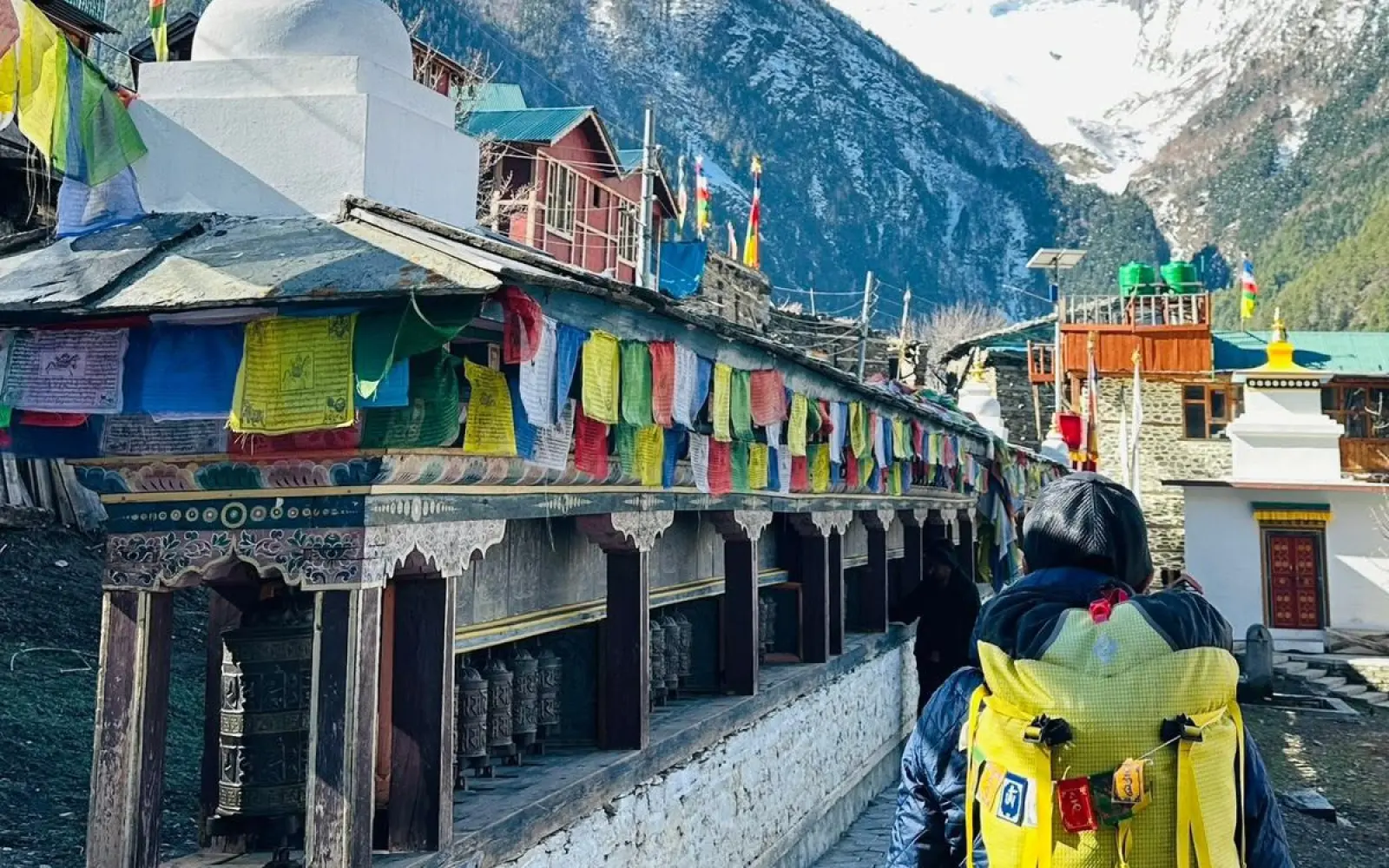
Imagine waking up to the smell of woodsmoke and ginger tea, looking out a frosted window to see a 26,000-foot peak glowing orange in the early sunrise. For countless armchair travelers, this sounds like a beautiful dream reserved exclusively for elite mountaineers carrying ice axes and oxygen tanks. Fortunately, you do not need to be a professional climber to capture this quintessential Annapurna experience. The journey around the Annapurna Massif—a colossal, snow-capped wall of Himalayan peaks in central Nepal—is actually an accessible high-altitude walking holiday rather than a technical, rope-and-harness expedition. If you can confidently hike for a few hours with a standard backpack, stepping into this ultimate Annapurna adventure is completely within your physical reach.
Spanning more than 100 miles, the full route feels much like a cross-state road trip, except you complete it entirely on foot over the course of two to three weeks. According to veteran Himalayan guides, an Annapurna trek provides a dramatic geographical diversity that easily outshines the starker, rockier Everest region. Trekkers typically begin their journey walking through lush, subtropical banana plantations and dense rhododendron forests. Within a week, those green valleys give way to a barren, high-desert landscape resembling the surface of the moon, offering a continuously changing visual reward as your lungs slowly adapt to the thinner mountain air.
Daily life on the trail quickly settles into a comfortable, deeply rewarding rhythm thanks to the region's unique local infrastructure. Rather than carrying heavy tents and shivering over freeze-dried camping rations, you will be "teahouse trekking," which means spending your nights in teahouses—small, family-run mountain lodges offering a warm bed, a hot shower, and a freshly cooked local meal. Industry data reveals that this welcoming network of lodges is exactly what allows average hikers to safely and comfortably conquer the famous Annapurna Circuit. Transitioning from an aspiring dreamer to a fully prepared trekker simply requires learning how these mountain communities operate, properly conditioning your legs for the daily miles, and understanding the incredible culture waiting for you on the trail.
Before you can set foot on the trail, you need the right keys to unlock the Himalayas. Nepal requires specific mountain entry passes, making the ACAP and TIMS permits your first logistical step. The ACAP (Annapurna Conservation Area Project) passes funds to local environmental protection, while the TIMS (Trekkers' Information Management System) card functions as a vital safety registry. By logging your progress through various trail checkpoints, authorities know exactly where you are if an unexpected storm rolls in.
Securing these documents is straightforward, whether you handle it yourself or enlist an Annapurna Circuit trekking agency. Independent hikers can pick up an Annapurna Circuit trekking permit directly at the Nepal Tourism Board offices in either Kathmandu or Pokhara. You simply need your passport, a few passport-sized photos, and a couple of hours to complete the paperwork. If you hire a local guide or tour operator, they usually manage this entire administrative process for you behind the scenes before your journey even begins.
A pleasant surprise for many hikers is the overall Annapurna Circuit cost, which is highly affordable compared to a standard Western vacation. Most travelers comfortably spend just $30 to $50 USD per day in the mountains. Here is a realistic daily cost breakdown to help you plan your budget:
Once you hand over your freshly stamped paperwork at the very first trail checkpoint, the logistical phase of your trip officially ends. With legalities sorted and a stack of Nepali Rupees safely tucked in your backpack, you are ready to experience the local culture firsthand. Prepare to step directly into the teahouse lifestyle: Himalayan hospitality and the "Dal Bhat Power" diet.
Imagine shedding your heavy boots after six hours of walking and gathering around a central, wood-burning stove. This is the heart of teahouse accommodation on high-altitude trails. Instead of sleeping in cold tents, you will stay in small, family-owned mountain lodges spaced every few miles. While the sleeping quarters are undeniably no-frills—usually offering just two basic wooden beds and unheated shared bathrooms—the communal dining spaces are incredibly warm and welcoming.
Staying in these lodges offers a rare chance for genuine cultural immersion in traditional Gurung villages. The Gurung people, renowned for their deep mountain heritage and hospitality, run many of the teahouses along the route. Because you are essentially a guest in an extended family home, basic etiquette matters. Removing your shoes before entering the dining room, ordering dinner early so the kitchen can efficiently prepare, and offering a polite "Namaste" transforms you from a passing tourist into a respected guest. If you hire a local Annapurna guide, they will seamlessly help you navigate these daily interactions.
When dinner finally arrives, you will discover the ultimate Himalayan soul food: Dal Bhat. This traditional platter is the undeniable fuel of the mountain, eaten by porters and trekkers twice a day without fail. It provides the heavy-duty nutritional profile your body needs to recover from steep ascents. A classic plate includes:
The greatest secret of this meal is the famous mountain refill culture. Teahouse hosts will continuously scoop hot rice and lentils onto your plate until you physically signal them to stop. Armed with this unlimited "Dal Bhat Power," your body will be fully primed for the drastically changing scenery ahead. You will need every ounce of that stored energy as you lace up your boots to transition from lush jungles to high deserts.
Looking at a standard Annapurna Circuit map, the trail appears as a line covering roughly 100 to 145 miles. However, framing this journey purely in miles is misleading because steep terrain dictates your speed. Instead, picture your Annapurna itinerary as a 12 to 18-day slow-motion walk through a vertical world. Over these couple of weeks, you will experience a dramatic environmental transformation that feels like walking from the equator to the arctic.
Your journey on the Annapurna route begins in the low, subtropical foothills near Besisahar. At roughly 2,600 feet, the air is thick and humid, with terraced rice paddies and cascading waterfalls dominating the landscape. As you hike upward over the next few days, the heat fades into a crisp, temperate forest climate filled with towering pines and rhododendrons. While climbing higher naturally brings colder weather, the dropping temperature is only half the story of this trek.
Everything changes drastically once you pass through the mountain town of Chame. The towering peaks of the Annapurna massif physically block rain clouds from moving north, creating a fascinating weather phenomenon known as the rain shadow effect. Because heavy clouds dump all their moisture on the southern side of the mountains, the northern side is left completely dry. Within just a few miles of walking, the dense forests vanish, replaced by the stark, windswept rock and sand of the Manang valley's alpine desert.
Surviving this incredible transition from humid jungle to temperate woodland and finally into a barren alpine desert requires constant physical adaptation. By the time you reach these high, arid plains, the atmosphere has grown noticeably colder and substantially thinner, naturally forcing a slower pace. The trees are entirely gone, leaving only sweeping panoramic views of ancient glaciers and jagged ridges. This desolate but stunning high-altitude zone serves as the ultimate staging ground for your final test: pushing toward the legendary Thorong La Pass.
Standing at 17,769 feet (5,416 meters), the Thorong La Pass represents the ultimate physical test of your journey. While looking at a Thorong La Pass elevation map might make the climb seem like a simple slope, the reality is much more complex. Up here, every step feels like carrying heavy groceries up stairs while breathing through a straw. Conquering this legendary saddle isn't about raw athletic power; it is entirely about managing your body's transition into an oxygen-depleted environment during your Annapurna Circuit trekking experience.
As atmospheric oxygen decreases with elevation, recognizing how your body reacts is crucial. Acute Mountain Sickness (AMS) is your body protesting a rapid ascent, usually starting with a mild headache, slight loss of appetite, or nausea. Think of these symptoms like a car's check-engine light: early warnings requiring immediate attention, not an annoyance to push through. Ignoring them can lead to severe emergencies, making slow adaptation—known as acclimatization your most critical safety tool.
Preventing altitude sickness comes down to following proven practices rather than relying on luck. Guides enforce these golden rules to keep you safe:
Execution of your acclimatization strategy culminates in an early start on pass day, often long before sunrise. Guides typically initiate the summit push around 4:00 AM, a schedule specifically designed for managing physical fatigue and avoiding the ferocious afternoon winds. Waking up in the freezing dark sounds intimidating, but hiking under brilliant stars with headlamps bobbing ahead is a magical experience. By moving steadily through the dawn, you reach the summit flags safely by mid-morning, leaving ample time to descend before the weather turns hostile.
Beyond just resting in a teahouse, many hikers find that the best way to physically adapt is through active exploration. For trekkers with a flexible itinerary, stepping off the main trail offers both a physiological advantage and a breathtaking reward. Instead of waiting idly for your body to adjust, you can use your acclimatization time to visit a spectacular hidden gem: The Tilicho Lake Detour, adding the world's highest lake to your journey.
Stepping off the main route to visit a sapphire-blue body of water nestled among glacial peaks transforms a great trek into an extraordinary one. Choosing an Annapurna Circuit trek with Tilicho Lake typically adds three days to your itinerary, but the detour pays massive dividends in both scenery and acclimatization. At 16,138 feet (4,919 meters), this icy expanse holds the title of the world's highest lake of its size. Reaching its shores feels like discovering a secret frozen kingdom, far removed from the busier paths of the standard trekking route.
The physical journey to this alpine marvel introduces one of the most infamous geographic features of the region: the Landslide Area. When evaluating your Tilicho Lake side trip options, you must honestly assess your comfort with heights and narrow paths. This specific stretch crosses a steep, loose rock slope where the path is sometimes barely wider than your boots, resembling a slanted, gravel driveway that drops off sharply into the valley below. While you never need technical climbing gear or ropes, crossing safely requires steady footing, a calm mind, and the stamina for a rigorous hiking day.
Beyond the breathtaking photographs, conquering this detour provides a significant psychological and physiological advantage for your ultimate goal. By exposing your body to the thin air at nearly 5,000 meters, you create a highly effective trial run for the Thorong La Pass. Returning to the main Annapurna hiking trail after this success makes the looming summit feel much less intimidating because you have already proven your physical resilience. With the most demanding mountain tests finally in your rearview mirror, your focus gradually shifts toward the descent, bringing up the final logistical choice of booking a quick scenic flight from Jomsom or taking the rugged road to Pokhara.
Reaching the windswept town of Jomsom feels like crossing the ultimate finish line of your Annapurna Circuit tour. While purists once walked the entire loop, the construction of a rugged "New Road" has fundamentally changed the final three days of the traditional itinerary. Instead of peaceful forest trails, hikers now share dusty, unpaved tracks with local traffic winding through the Kali Gandaki Gorge, the deepest canyon in the world. Because walking this motorized stretch often lacks the magic of the high mountains, most modern trekkers choose to end their foot journey in Jomsom and ride the rest of the way.
The overland route down to the lakeside city of Pokhara guarantees an authentic, albeit jarring, Nepalese travel experience. For about $15, you can book a seat on a local bus or share a jeep for a bumpy, eight-to-ten-hour descent. Just as you likely experienced with your initial transportation from Kathmandu to Besisahar at the start of your trip, this ride is an exercise in patience. It offers a fascinating, ground-level view of changing landscapes as barren cliffs transition back to lush, subtropical banana trees, provided you do not mind getting jostled around.
For those craving a smoother exit, booking a flight out from Jomsom offers an unforgettable alternative. These tiny mountain flights climb right between the towering peaks of Annapurna and Dhaulagiri, turning a grueling day-long drive into a spectacular 20-minute aerial tour. However, this convenience comes with two catches: a higher price tag of approximately $125 and a strict dependence on the weather. Because fierce winds rip through the Kali Gandaki Gorge by late morning, these flights only operate in the early hours and are frequently delayed or canceled if visibility drops.
Ultimately, weighing these transit choices comes down to your wallet and your remaining vacation days:
Whether you plan to soar above the gorge or bounce along its rocky roads, successfully navigating this diverse environment starts long before you arrive, bringing us to the crucial step of gearing up for the Himalayas: packing the essentials without overloading your pack.
You might think freezing mountain temperatures require a massive backpack, but the secret to comfortable Annapurna hiking is simply dressing like an onion. Instead of packing bulky coats, build your packing list for high-altitude trekking around a three-part layering system. Start with a moisture-wicking "base layer" (like a lightweight athletic shirt) to pull sweat away from your skin. Next, add an insulating fleece to trap body heat, and finish with a waterproof "shell" jacket to block the wind. If you need a heavy down jacket for freezing nights, just rent one in Kathmandu for a few dollars a day, saving both money and luggage space.
To keep your pack weight comfortably low, focus strictly on these "Big 5" daily essentials:
Staying hydrated at high elevations is critical, but buying bottled water creates terrible plastic waste in these fragile ecosystems. When treating water in remote mountains, your best defense is a rechargeable UV-light purifier or simple water purification tablets. These lightweight tools let you safely drink tap water directly from any teahouse. With your gear smartly packed and your hydration sorted, you are ready to bring everything together into a step-by-step action plan.
The Himalayas are not an impossible dream reserved for elite climbers. If you can confidently hike for five hours wearing a backpack, you are capable of preparing for a 20-day mountain trek. To make this a reality, initiate a simple six-month countdown. Start by selecting the best time to trek, typically during the crystal-clear weather windows of October or April, and commit to the journey by updating your passport or booking a flight. If you prefer expert guidance, this is also the ideal time to reach out to a reputable trekking agency to handle your logistics.
At the three-month mark, adopt a physical training schedule focusing on stairs and local trails while wearing a slightly weighted pack. Your ultimate measure of success on this trail is not about speed or breaking records; it is about personal enjoyment and deep cultural immersion. By conditioning your legs early, you ensure you will have the endurance to truly appreciate the towering glaciers, the high-desert transitions, and the warmth of sharing meals in cozy mountain teahouses.
The Annapurna Circuit is not simply a trek. It is a complete transformation of perspective. Over the course of two to three weeks, you will walk through subtropical jungles and lunar deserts, share meals with mountain families who have called these valleys home for generations, push your lungs to their limits at one of the world's highest mountain passes, and descend back into the warmth of Pokhara carrying a quiet confidence that only the Himalayas can give you.
What makes this journey truly remarkable is its accessibility. You do not need a technical climbing background, an elite athlete's body, or an unlimited budget. You need broken-in boots, a willingness to slow down, and the patience to let the mountains set the pace. Every steep climb rewarded with a jaw-dropping ridge view, every steaming plate of Dal Bhat refilled without asking, and every sunrise painting the snow-capped peaks gold is a reminder that some of the world's greatest experiences are available to anyone bold enough to simply show up.
There will be mornings when your legs ache and the pass feels impossibly far away. There will be afternoons when the wind cuts through every layer you packed and the teahouse still feels like an hour out of reach. But there will also be moments so quietly beautiful that you stop mid-trail just to take them in. Those are the moments that stay with you long after the blisters heal.
So pull out your passport, mark October or April on your calendar, and start climbing those stairs with a weighted pack. The Annapurna Circuit has been waiting for you and it is every bit as magnificent as you imagined.


