 5.0 of 433 reviews
  5.0 of 309 reviews 5.0 of 433 reviews 5.0 of 309 reviews
The Everest Three Passes Trek is a famous circuit in Nepal’s Khumbu (Everest) region. It typically lasts about 18–21 days (starting and ending in Lukla) and covers all the Everest highlights – Everest Base Camp, Kala Patthar, the Gokyo Lakes – plus three high mountain passes. In other words, it’s much more than the classic Everest Base Camp (EBC) trail.
The trek gains altitude quickly (crossing 5,535 m Kongma La, 5,420 m Cho La, and 5,360 m Renjo La), so the question “How difficult is the Everest Three Pass trek?” is common. In short, this is a strenuous, high-altitude trek that demands good fitness and careful preparation. Most guides classify it as significantly tougher than the standard EBC trek.
However, It is a wonderful experience with wide views of Everest, Lhotse, and Makalu, and a chance to see Sherpa culture and the beautiful Gokyo Valley. Despite its challenges, the Three Passes trail has good teahouse lodges along the way, and with proper preparation and gear, it is achievable for most trekkers. We will discuss the path and difficulties in order to make a beginner, intermediate, and professional trekker aware of what to expect.
The three passes, altitude issues, fitness and equipment requirements, weather, and the question about whether it is more challenging to climb the Everest Three Pass with or without a guide all become clear and we explain why the scenery is so amazing and it is worth the effort.
The main challenge of the trek is the fact that it involves three high passes, each having its terrain and level of difficulty. From east to west, they are Kongma La, Cho La, and Renjo La. Crossing each pass is a full day’s hard work (typically 6–9 hours) with steep ascents and descents.
The first pass is Kongma La (often spelled Khongma La) at about 5,535 m. The route usually starts from the village of Chhukung (4,730 m) after a rest day. The climb is long but steady. You’ll ascend moraines and rocky slopes in the Imja Tse valley toward Everest’s southwest ridge. According to trek guides, the climb to Kongma La is gradual and not extremely difficult, but it does include some icy patches. After 6–9 hours of uphill walking (about 10–11 km, one way), you reach the pass, marked by prayer flags and cairns.
The real test is the descent. From the pass, you drop steeply across the Khumbu Glacier toward Lobuche. This downhill section is very rocky and can be slippery, often requires a careful steps on loose rocks and ice. Guides note that although Kongma La is the highest pass, its ascent is manageable, but the steep descent over the glacier can be tough. Wear good boots and use trekking poles. Once down the glacier moraine, trekkers head to Lobuche village (4,940 m) for a rest.
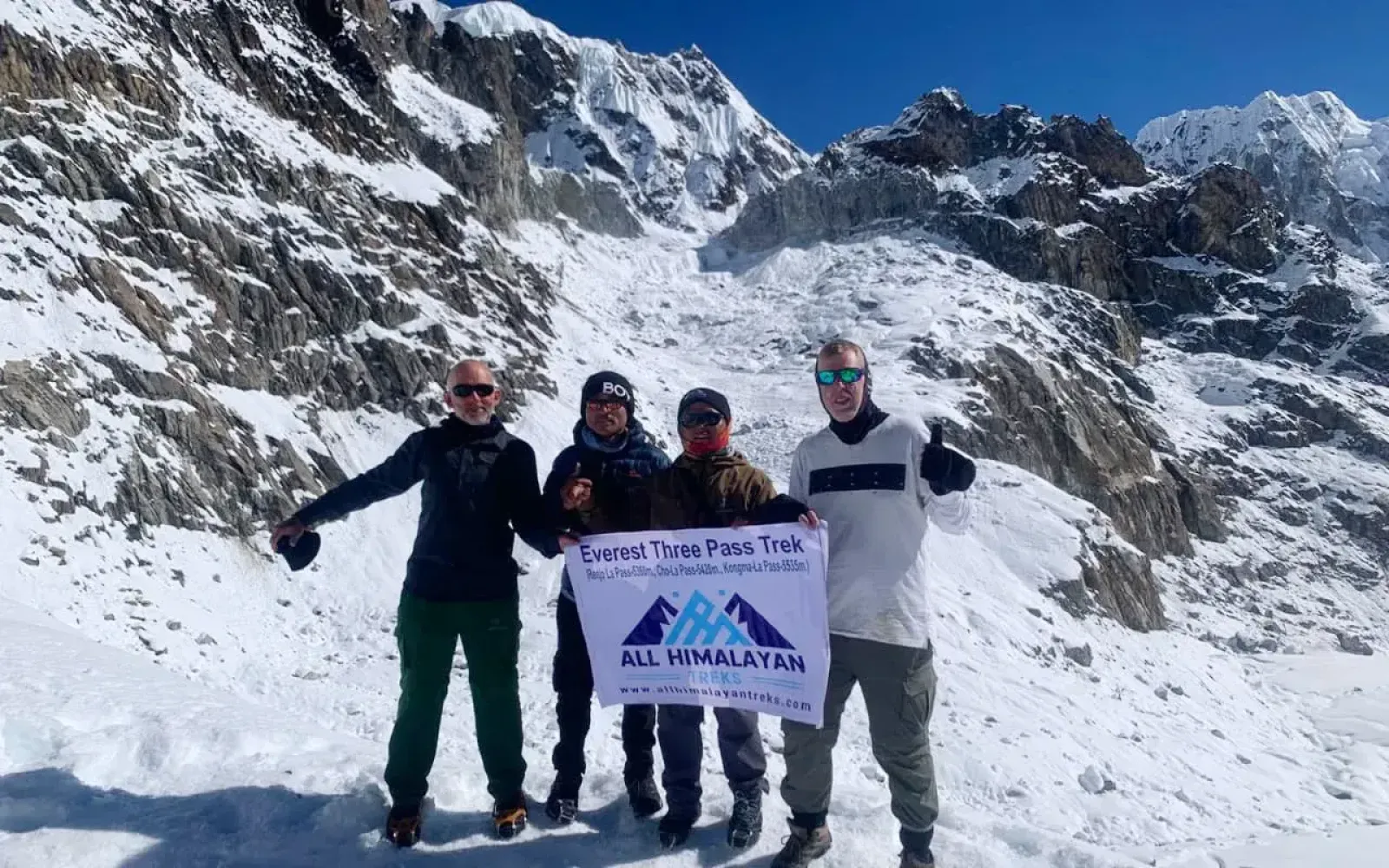
Climbers pass through the icy slopes of Cho La Pass, which many describe as the hardest of the three high passes.
The second pass, Cho La (5,420 m), comes after returning to Gorak Shep/Everest Base Camp area and heading west toward Gokyo. The ascent from Dzongla (4,830 m) to Cho La takes about 3–4 hours (roughly 5–8 km). This climb can feel very steep: you gain about 700 m in altitude over a rocky, icy trail. Views from Cho La on a clear day include peaks like Cholatse, Nirekha, and Lobuche.
Trekkers often consider Cho La the toughest of the three passes. The upper ridge involves steep, narrow sections and ice, so even experienced hikers must watch their footing. Once on top, the descent is again challenging – a long 2–3 hour drop of roughly 700 m into the Thagnak area of the Gokyo Valley. The downhill is rocky and can be very slippery, so take it slow. In bad weather, strong winds and ice can make Cho La even more difficult.
Renjo La (5,360 m) is the final pass on this circuit. It is typically climbed after a day’s trek from the Gokyo Lakes area. The ascent from Gokyo (4,750 m) to Renjo La is shorter (about 4.5 km of trail), and by this point most trekkers are well-acclimatized. Renjo La offers spectacular views – on a clear morning you can see Everest, Lhotse, Makalu, Cho Oyu, Ama Dablam, and more.
Many guides say Renjo La is the easiest of the three passes. There are no major glacier crossings on this climb – just steep trail with occasional snow patches. It still takes around 4–5 hours up with the load. The descent is a long hike down to the Bhote Koshi valley, ending in the small village of Lungden (4,340 m) or Thame. The trail down is steep but not technical.
Key Pass Points: Kongma La is the highest (5,535 m) but has a more gradual climb. Cho La (5,420 m) has very steep and icy sections – many trekkers rate it the hardest pass. Renjo La (5,360 m) comes last and is considered the safest and most scenic of the three. All passes require a full day of hiking with heavy packs (prepare for 6–9 hour walking days on pass-crossing days).
One of the key determinants of the difficulty of the Everest Three Pass trek is the altitude. You start at Lukla (2,860 m) and quickly ascend into the high Himalaya. Trekkers spend nights at places like Namche Bazaar (3,440 m), Dingboche (4,410 m), Chhukung (4,730 m), and Gorak Shep (5,140 m), culminating in passes over 5,300 m. At these heights the air is thin – oxygen is about half what it is at sea level.
Acute Mountain Sickness (AMS): Above around 3,000 meters, symptoms such as headache, dizziness, nausea and fatigue may occur, with each step higher, the risk increases. All people acclimatize at different rates hence it is essential to pay attention to your body. Such precautions as climb high, sleep low are recommended: it is only advisable to increase in height a little each day, and descend at the end of the day to sleep in a lower place.
Both guides and trekking doctors advise taking extra rest days at key stops (Namche Bazaar and Dingboche are common acclimatization spots). Staying well-hydrated and eating enough carbohydrates also help your body adjust.
Acclimatization Days: Most itineraries for the Three Pass trek build in at least 2–3 days for acclimatization. On a rest day you might go on a short hike (for example, up to Everest View Hotel from Namche) and then come back down, which helps the body adapt without moving camp higher each night.
If any symptoms of AMS occur (severe headache, confusion, shortness of breath), don’t push on – descend immediately. All Nepal Hiking advises trekkers to recognise and manage altitude sickness by walking slowly and taking rest when needed. It’s far better to take an extra day than force progress.
By the time you reach the passes, you will have several nights above 4,000 m, which greatly improves your tolerance. Nepal Trekking Routes notes that with proper acclimatization, many trekkers find the later passes easier because they are better adapted.
Nevertheless, those 5,300–5,500 m crossings remain strenuous. Make sure to carry Diamox (acetazolamide) or consult a doctor if you are prone to altitude sickness. In brief, the biggest obstacle is altitude: you should ascend gradually, monitor your signs, and be prepared to retrace your steps.
The Everest Three Passes Trek is not an easy trek. It involves long days of uphill hiking with a pack, and the terrain can be uneven, steep, and rocky. Even apart from altitude, a typical trekking day might mean 8–9 hours on your feet with an ascent of 500–700 m. Therefore a high level of physical fitness is strongly recommended.
Guides emphasize endurance training. Aim to do at least 2–3 months of preparation before you go. This should include aerobic workouts (running, cycling, stair climbing) and long hikes with a loaded backpack. For example, practice hiking 10–15 km on hilly trails in one day, gradually increasing weight and distance.
Strength exercises (lunges, squats, core work) will help with the frequent ups and downs and steep steps. If possible, do at least one weekend trek carrying 10 kg to mimic conditions. Nepal Trekking Routes advises that trekkers train specifically with cardio and leg strength because the Three Pass route involves steep ascents and descents.
Training with stair climbs, treadmill or hill intervals can simulate uphill effort. Don’t neglect hiking poles in your preparation – they significantly reduce knee strain on the downhill sections.
Beyond training, general health matters. Make sure any chronic issues (heart, asthma, joints) are well managed before attempting this trek. Being a bit overweight or out of shape will only make the journey harder. That said, many non-athletes complete this trek successfully with steady training. The key is consistency: build up stamina progressively.
In practice: On trek, expect 6–9 hours of hiking per day with significant altitude gain on many days. Trekkers typically carry 8–12 kg, since most will hire a porter to do the rest. If you regularly hike with 10 kg and can comfortably do 8-hour hikes with steep sections, you’ll have a good foundation. But be honest about your limits: if you’re only comfortable with flat walks, consider an easier trek first. Guides are unanimous – this route is best for experienced hikers.
The season you choose has a huge impact on trail conditions and difficulty. Nepal has four main seasons, and only two are ideal for the Three Pass trek.
In all seasons, be prepared for sudden weather changes. Even in spring or autumn, an unexpected snow squall or high winds can occur on the high passes. Always carry a warm jacket and rain gear on pass days regardless of season. According to Nepal Trekking Routes, weather shifts (snow or storms) are among the main challenges– so keep an eye on forecasts, start your pass crossings early in the morning, and turn back if conditions worsen.
In summary, spring and autumn offer the most hospitable conditions for the Three Pass trek. In these times you’ll face the least snow and rain, which makes the journey substantially easier and safer. In any season, nights at altitude are extremely cold, and carry warm clothes.
The Everest Three Pass trek also has some general challenges. The following are the key challenges faced by trekkers, and how to deal with them:
Trekking with the proper gear (warm clothing, a good sleeping bag) goes a long way to overcoming the elements. If you encounter difficulties beyond your control (severe AMS, a storm on the pass), don’t hesitate to turn back or wait it out — safety comes first. Plan conservatively, be ready for the unexpected, and keep a positive attitude. Many trekkers report that thorough preparation (training, gear) makes the journey feel hard but manageable.
One choice every trekker makes is whether to go fully independent or hire a local guide and porter. Neither option is required by law in Nepal (you only legally need permits), but each has pros and cons given the trek’s difficulty.
You must carry maps/GPS, be very diligent about acclimatization, and handle any emergency alone. As Nepal Trekking Routes notes, going independent is “a challenging yet rewarding adventure” but is “not recommended unless you have previous high-altitude experience”. If you choose independence, move slowly, double-check directions at forks, and consider joining a small group (even other trekkers at lodges) on pass days for safety.
Advantages: Greater security and comfort, reduced weight, and a person to do logistics (permits, hotel reservations, meals). Disadvantages: Extra cost (usually some hundreds of dollars on the trek) and the lack of flexibility (you will likely follow the group timetable).
Every guide concurs that it is strongly advisable to hire a guide/porter when doing the Three Pass trek. It takes away the weight of navigation and the weight of the packet and the guide can keep an eye on you in the event of any problems in altitude.
Especially for beginners, the extra expense of a guide is worth it. Trekking companies in Kathmandu will provide licensed guides who know the trails. Whichever way you go, having at least a porter is a huge help – carrying heavy gear at altitude would otherwise exhaust you. In the end, safety and enjoyment are paramount; the extra support of a guide/porter will make the difficult parts much easier.
The Everest Three Passes Trek is best suited for fit, experienced trekkers. It’s designed for people who are comfortable hiking many days in a row in rugged, high terrain. In practical terms:
In compare, this trek is not recommended for: - Casual tourists or those afraid of strenuous hikes. - Anyone who hates cold or heights. - Unprepared beginners with no high-altitude experience. If you’re unsure of your readiness, remember that local guides and even this article will clearly say: this is meant for seasoned trekkers. Before attempting the Three Pass, one can always do some experience in a shorter trek (such as Annapurna Base Camp or the lesser Everest Panorama trek).
It is extremely strenuous, physically and mentally. You will spend weeks living at high altitudes, doing long daily hikes, and facing cold, thin air, and possible storms. Every source emphasizes that this is one of Nepal’s toughest popular treks. It pushes you beyond the classic EBC trek and requires real grit.
However, the rewards are amazing to those who plan well and stick with it. You’ll cross three towering passes and see sights that few people do in one trip – the serene Gokyo Lakes from above, the longest Ngozumpa Glacier, the distant views of Cho Oyu and Makalu, and of course multiple angles on Everest and other 8,000-meter giants.
Completing this trek brings a enormous sense of achievement. Nepal Trekking Routes appropriately describes it as a trek that tests your physical limits, rewards you with unmatched panoramic views, and immerses you in rich Sherpa culture. Many trekkers say these highlights, standing on top of each pass with Everest in view, are worth all the effort along the way.

Our travel experts are ready to assist you with any questions.
Send us a message.Have a question before you book? Send your enquiry below and our travel experts will get back with the required information.