 5.0 of 433 reviews
 5.0 of 309 reviews 5.0 of 433 reviews 5.0 of 309 reviews

If you've been dreaming of the Himalayas but can't carve out a month, the Short Annapurna Circuit Trek might be exactly what you're looking for. This short Annapurna Circuit trek includes everything that makes the classic route legendary. It also fits a timeframe that works for real people with real schedules.
You'll wake up to the Annapurna and Dhaulagiri ranges painting the sky every morning. You'll push your legs and lungs over the mighty Thorong La Pass. And somewhere between a bowl of steaming dal bhat in a small teahouse and a chat with a Gurung grandmother, you’ll realize something.
This wasn’t just a hike. It was something that stays with you.
This short annapurna circuit trekking guide will walk you through everything you need to plan confidently and enjoy every step.
Think of it as the greatest hits version of one of the world's most celebrated treks. The Short Annapurna Circuit Trek is a compact journey — often completed in 8 to 9 days — that captures the soul of the full circuit without demanding three or four weeks of your life.
You start in Besisahar and finish in Jomsom or Pokhara, and in between, the landscape shifts dramatically beneath your boots. Subtropical forests give way to alpine meadows, which eventually surrender to the raw, windswept high-altitude desert of the Mustang borderlands. It genuinely feels like trekking through several different countries in one trip.
Along the way, you pass through traditional Gurung and Thakali villages where life moves at a gentler pace. The stone houses with carved wooden windows, the women grinding millet on flat stones outside doorways, the prayer wheels spun by monks since the 14th century — this isn't scripted culture. It's daily life you happen to walk through. This annapurna trek itinerary doesn't cut corners on the highlights that matter.
Honestly? Because life is busy, and waiting for the "perfect" two-month window that never comes means missing out on something extraordinary.
This trek is built for people who are time-poor but experience-hungry. Despite the shorter duration, nothing feels rushed or watered-down. The mountain views are just as humbling, the cultural encounters just as genuine, and crossing Thorong La Pass is just as much of an achievement whether you've been walking for eight days or eighteen.
It's also genuinely welcoming to trekkers of all levels. First-timers find it manageable with the right preparation, while seasoned hikers appreciate the terrain's variety and the altitude challenge. You'll find practical Annapurna Circuit tips throughout this guide to help you prepare.
Why people keep choosing this trek:
The Himalayas don't really do "mild and forgiving" as a default, so timing your trek matters more here than almost anywhere else.
Spring (March to May) is a wonderful time to go. Temperatures are comfortable, the skies tend to be clear, and the rhododendron forests burst into vivid blooms that make the whole trail feel cinematic. If you love colour and don't mind the odd afternoon cloud, spring is magical.
Autumn (September to November) is arguably the best window. The monsoon has washed everything clean, the air is sharp and crisp, mountain visibility is outstanding, and the trails are dry and well-maintained. October in particular offers the most reliable conditions for crossing Thorong La Pass. This is peak trekking season for good reason.
Worth noting: the Upper Manang Valley sits in a rain shadow, staying relatively dry even during monsoon months, which makes that stretch surprisingly manageable year-round. However, lower sections during June–August bring leeches, slippery trails, and landslide risk on the mountain roads — not ideal.
Optimal trekking seasons at a glance:
This Annapurna trek itinerary flows naturally. It gives you time to acclimatize and enjoy the scenery. You won’t feel like you’re racing the clock. Here's how a typical 8-day version unfolds:
Day 1 — Drive
From Kathmandu to Besisahar, then take a jeep to Chame (2,650m). It’s a long travel day. It takes about 12–14 hours total. But it sets the tone beautifully. You board a bus at Kathmandu's Gongabu Bus Park for the 173 km trip to Besisahar.
Then you transfer to a shared jeep for the rough, scenic 66 km mountain ride to Chame. Watch the landscape shift from urban sprawl to rice terraces to pine-forested river valleys. By the time you reach Chame, you're already breathing different air.
Day 2 — Chame to Upper Pisang (3,300m) | ~6 hours.
A 14km walk beside the Marsyangdi River, through pine forests.
Cross suspension bridges over milky glacial channels. You'll pass the sacred Mani Wall at Bratang Gompa, where faded carved stones bear centuries of mantras. Upper Pisang rewards you with your first panoramic views of Annapurna II and Gangapurna massifs.
Day 3 — Pisang to Manang (3,519m) | ~5 hours
A gentler 16km day through rhododendron forests and seasonal yak pastures. The Manang Valley floor surprises you with its Martian red soil and ancient irrigation canals. Locals here still practice traditional sky burials on hilltops. The village has a raw, end-of-the-world feel that's oddly captivating.
Day 4 — Acclimatization Day in Manang
The most important day on the trek — and one that gets skipped at your peril. Choose between the Ice Lake hike (4,620m), which climbs through glacial moraines and offers staggering views, or the Gangapurna Base Camp route (4,130m), a slightly gentler option.
Either way, the "climb high, sleep low" principle does its quiet work while you're exploring. Guides monitor oxygen saturation levels throughout. Come back, eat a big carb-heavy dinner, and sleep.
Day 5 — Manang to Chauri Lader via Yak Kharka (3,720m) | ~3–4 hours
The landscape turns lunar above 4,000m. Vegetation disappears, yaks appear, and nomads brewing butter tea in stone shelters become your landmarks. You'll smell the smoke before you see the teahouse. A shorter day that gets you in position for what comes next.
Day 6 — Chauri Lader to Thorong Phedi (4,450m) or High Camp (4,880m) | ~3–4 hours
A short but significant ascent toward the base of the pass. Oxygen concentration here is around 58–60% of sea level — you'll notice it. Some trekkers push to High Camp for a slightly shorter crossing tomorrow; others stay at Thorong Phedi and leave earlier. Either way, eat well, sleep early, and set two alarms.
Day 7 — Thorong La Pass Crossing to Muktinath (3,710m) | ~8 hours
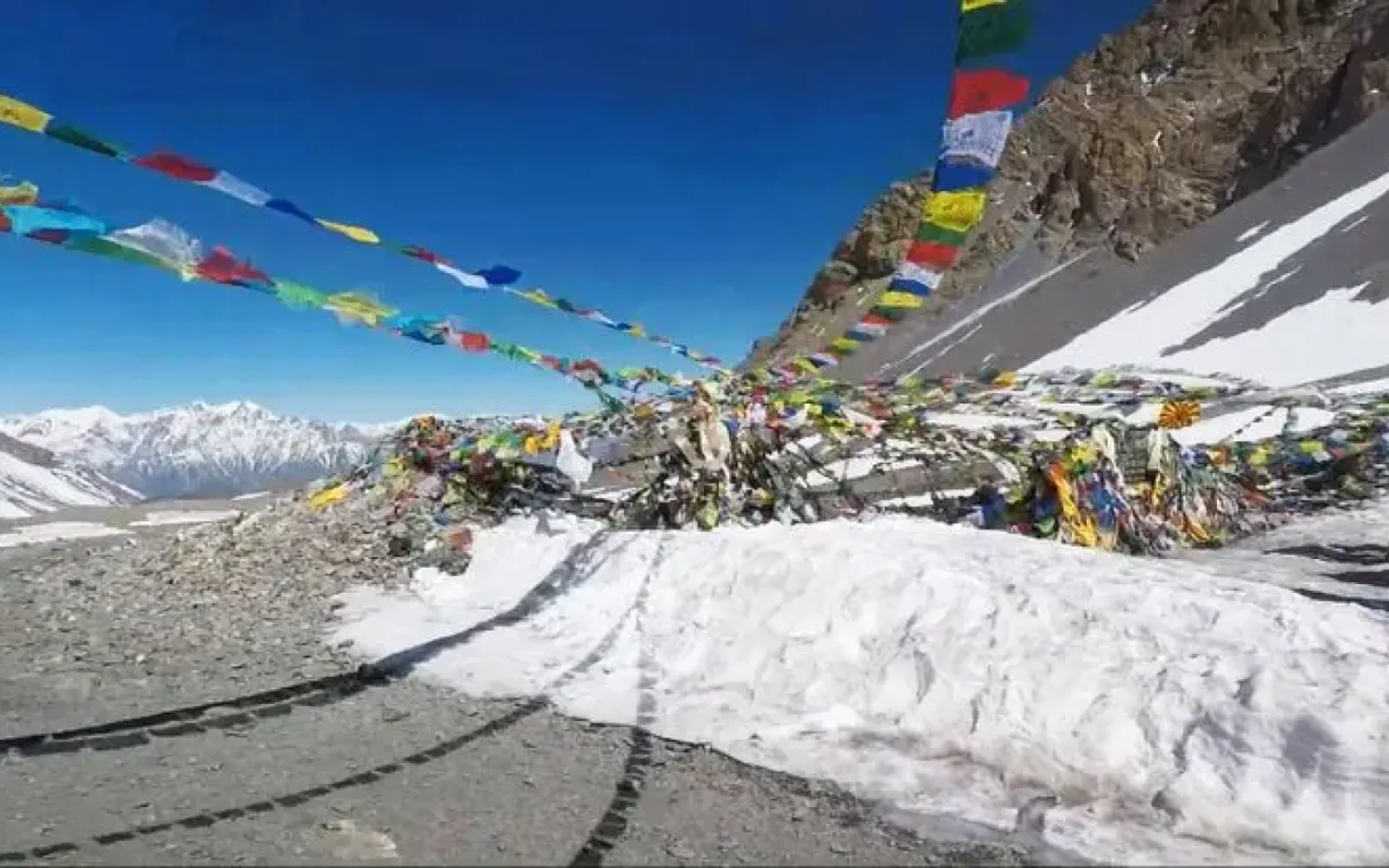
The big one. Pre-dawn start, headlamps out, switchbacks through rocky terrain as the stars fade above Dhaulagiri's snow peaks. The pass summit at 5,416m marks the watershed between two major river systems — and you'll feel every meter of it. Then the descent to Muktinath, a deeply sacred pilgrimage site where an eternal flame burns beside freezing water spouts, sacred to both Hindus and Buddhists. After crossing the roof of the world, wandering through ancient temple grounds in the late afternoon light feels genuinely surreal.
Day 8 — Drive Muktinath / Jomsom to Pokhara (822m) | ~10 hours
Board a local bus for the long descent through canyon walls, terraced farmlands, and market towns. Watch the vegetation thicken as the elevation drops. Lunch at a roadside dal bhat spot somewhere in the middle. By the time you reach Pokhara and check into a proper hotel with a hot shower and a real bed, you'll have earned every second of it.
A quality-guided trek of this kind typically covers the following (based on the All Himalayan Treks package):
Included:
Not Included:
Group pricing:
No two days on this route look the same, which is part of what makes it so compelling.
Moments you won't forget:
Before you set off, you need two permits — and as of 2023, the process is actually simpler than it used to be.
The Annapurna Conservation Area Permit (ACAP) costs NPR 3,000 for foreign nationals and is the main entry requirement. The TIMS card requirement has been suspended for the Annapurna region as of 2023, which simplifies things. You'll still encounter permit checkpoints at Chame and Manang, so carry your ACAP documentation (and your passport) throughout the trek.
Both can be obtained in Kathmandu or Pokhara. If you're trekking with a registered agency, they'll handle the paperwork during your Kathmandu orientation — but you'll need to have your valid passport ready.
Teahouses are the heartbeat of any Annapurna trek. These small, family-run lodges offer a warm bed, a hot meal, and genuine mountain hospitality that feels special after a long day on your feet.
Don't expect luxury — rooms are simple, shared bathrooms are common, and WiFi is spotty at best (expect to pay $3–$4 per session). But the warmth and welcome more than compensate, and some teahouses surprise you with incredible views right from the dining room.
Food-wise, dal bhat is your best friend. Hearty, warming, and comes with refills. Momos, thukpa, and the occasional pizza round out the menu at most teahouses. Food choices thin out above 4,000m due to supply constraints, so eat well when you can.
A note on hot showers: most teahouses offer them for a small fee (typically $1–$2), and after a cold night at altitude, they become one of life's great luxuries.
Pack smart, not heavy. You're carrying everything every day, so discipline counts.
Your essential checklist:
This is the part of the trek where overconfidence gets people into real trouble. Altitude sickness doesn't discriminate — it hits fit, experienced trekkers just as readily as beginners.
Good guides carry pulse oximeters and check oxygen saturation twice daily. If readings drop below 80%, descent is immediate — no discussion. That said, the best approach is prevention, not reaction.
Practical acclimatization tips:
Yes — with the right preparation and realistic expectations.
You'll reach 5,416m at Thorong La Pass, which demands real cardiovascular fitness and altitude adaptation. You don't need technical climbing skills, but you do need to be comfortable walking 6–8 hours daily on varied terrain. The built-in acclimatization day in Manang is specifically designed to support first-time high-altitude trekkers.
If you're starting from scratch, aim for 6–8 weeks of dedicated preparation — stair climbing, loaded hikes, and cardiovascular training. Break in your boots well before departure. Pack your patience along with your gear. The mountains are achievable; they just ask that you show up prepared and humble.
A few habits separate trekkers who finish feeling incredible from those who just survive the experience.
Essential Annapurna Circuit tips:
The journey begins at Kathmandu's Gongabu Bus Park, where you board a bus for the 173km, 7–8 hour ride to Besisahar. From there, a shared jeep covers the rough 66km mountain stretch to Chame in another 5–6 hours. It's a long first day, but it's also where Nepal starts to reveal itself.
At the end of the trek, a local bus descends from Muktinath/Jomsom to Pokhara — a 10-hour journey through dramatic canyon scenery, terraced farmland, and roadside dal bhat stops. You can also arrange onward travel back to Kathmandu from Pokhara by tourist AC bus (6–7 hours).
For device charging and internet: most teahouses have charging available at $1–$3 per device (prices increase at higher elevations). WiFi costs around $3–$4 per session. Download offline maps before you leave — don't rely on connectivity above 4,000m.
The Annapurna region is extraordinary, and it stays that way because of how people treat it.
Your ACAP permit fees directly fund trail maintenance, reforestation, waste management, and community development in the region. That's not just paperwork — it's a contribution to a place that gives you so much.
Simple ways to trek responsibly:
What makes this trek "short"? It's a condensed 8–9 day version of the classic Annapurna Circuit. You start in Besisahar and finish in Jomsom or Pokhara, crossing Thorong La Pass with an acclimatization stop in Manang — all the key highlights, a fraction of the time commitment.
Do I need a guide? Legally, foreign trekkers in the Annapurna region must be accompanied by a licensed guide. Beyond the legal requirement, a good guide genuinely transforms the experience — they add context, safety, and stories that no blog post can replicate.
What permits do I need? The ACAP permit (NPR 3,000) is the main requirement. As of 2023, the TIMS card requirement has been suspended for this region. Secure your ACAP in Kathmandu or Pokhara before heading to the trailhead, and carry your passport throughout the trek.
How do I get to the starting point? Bus from Kathmandu's Gongabu Bus Park to Besisahar (7–8 hours), then a shared jeep to Chame (5–6 hours). A good agency handles all of this as part of the package.
Can I charge electronics on the trek? Most teahouses offer charging, but it's solar-dependent and unreliable above 4,000m. Bring a power bank.
Is this trek right for beginners? Yes, with proper preparation. You need a moderate fitness base and 6–8 weeks of training beforehand. The acclimatization day and gradual altitude gain make it achievable for first-timers who prepare seriously.
If you want a trek that delivers genuine Himalayan magic without demanding half your annual leave — yes, it absolutely is.
The Short Annapurna Circuit Trek packs extraordinary landscapes, cultural richness, and real personal challenge into 8–9 days that feel both adventurous and human-scaled. From the first dusty jeep ride into the mountains to that pre-dawn climb toward Thorong La Pass, to the quiet, slightly stunned feeling of sitting in a Pokhara hotel room afterwards — this trek has a way of resetting your perspective.
Whether you're stepping into high-altitude trekking for the first time or you're a seasoned mountain wanderer looking for something focused and rewarding, this route has something real to offer. Pack your boots, get your permits sorted, and go. The mountains aren't going anywhere — but the window to experience them like this is always shorter than you think.

Our travel experts are ready to assist you with any questions.
Send us a message.Have a question before you book? Send your enquiry below and our travel experts will get back with the required information.