
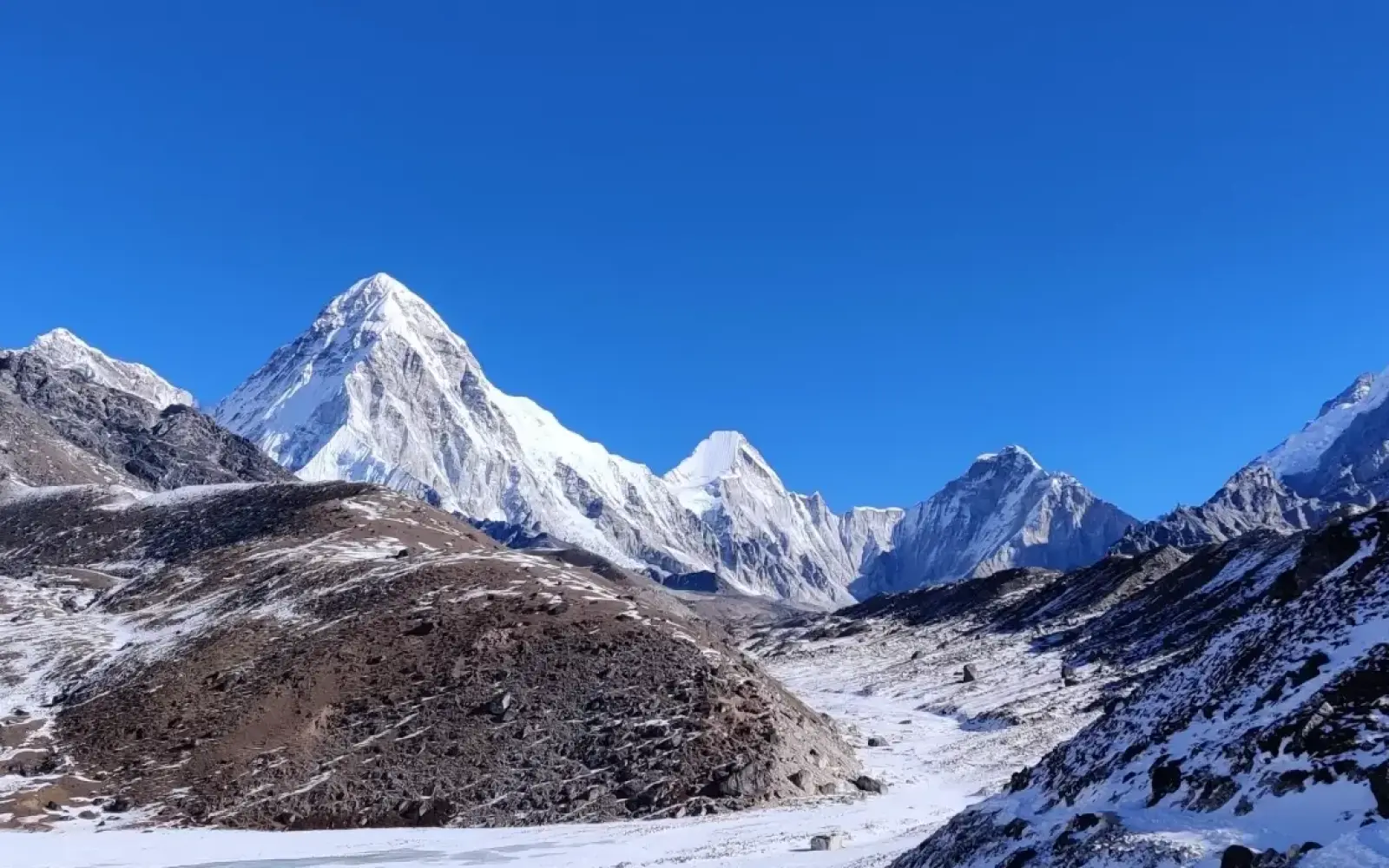
The eight of the fourteen 8,000 meter+ peaks can be found in Nepal to support the adventure of trekkers and climbers wanting to experience the breathtaking beauty of Nepal’s Himalayan Mountain Range as well as the rich Sherpa culture.
Mount Everest, the highest mountain in the World, at 8,848.86m, is located between Nepal and Tibet in the Khumbu Mahalangur Himal. The first two climbers to summit Mount Everest were Sir Edmund Hillary and Tenzing Norgay in 1953; since that time, Mount Everest has become one of the most coveted challenges for climbers and the most famous of the world’s mountains. The traditionally used route to reach the summit of Mount Everest is the Southeast Ridge, south ascent from Nepal. Base Camp trekkers pass through Namche Bazaar and the Khumbu Icefall to reach Everest Base Camp; thousands of trekkers complete this trek every year. For climbers, the most significant challenge will be the Hillary Step, along with climbing at altitude. As of 2026, there have been over 6,000 successful summits. The prominence of Mount Everest as the world’s highest mountain has created many famous treks to Base Camp, some of which are physically demanding while others incorporate cultural experiences.
Kanchenjunga (8,586m), the second tallest mountain in Nepal, is located in the northern part of Nepal in a region of the Kanchenjunga Massif bordering Sikkim, India. Kanchenjunga translates to, “Five Treasures of Snow,” and has multiple peaks that comprise Kanchenjunga, which includes the Main Summit, West, South, Central and Kangbachen.
Charles Evans' 1955 expedition was the first to successfully summit Kanchenjunga. The Limbu natives, who hold the peak in high esteem, refrain from climbing it because they reserve climbing to the true summit out of respect for the mountain's sacred nature. The Kanchenjunga Base Camp Trek is the preferred route for trekkers to reach Kanchenjunga as it involves traversing the Yalung Glacier and crossing through many ecosystems from the subtropics to ice.
Lhotse is the fourth highest mountain in the world, standing at 8,516 meters and part of the Everest Group just south of Everest. Lhotse shares its South Col climbing route up to 8,000 meters with Everest. Lhotse has three peaks: Lhotse Main, 8,516 meters; Lhotse Middle, 8,414 meters; and Lhotse Shar, 8,383 meters. The first successful summit of Lhotse was in 1956 by Fritz Luchsinger and Ernst Reiss.
The Lhotse summit's steep, rocky face and the potential for avalanche danger make Lhotse a favourite climbing destination for experienced climbers looking for a technical climb at about half the cost of Everest. The route to Lhotse is from the same paths as the Everest Base Camp Trek, also providing excellent vistas of Everest's southwest face. Due to their close proximity to each other, many elite climbers do both climbs during their mountain expeditions to Everest and Lhotse; therefore, Lhotse and Everest expeditions are in great demand.
Makalu is the fourth highest mountain in the world, and at 8,481 meters, is part of the Makalu Mahalangur Himal. Recognised for its stunning, four-sided pyramid shape, Makalu required both Jean Couzy and Lionel Terray to make the first recorded summit of Makalu in 1955. As a result, Makalu is considered one of the most difficult mountains in the world. Due to the mountain's unique and exposed ridges, climbers will require advanced climbing skills to safely summit Makalu.
On treks to Makalu Base Camp (located east of Everest) through the Barun Valley (a biological hotspot encompassing both rhododendron forests and alpine meadows), you can experience the mountain's remoteness with the need for special permits to visit this area, providing solitude while experiencing some of the most beautiful ice falls in the world. It’s ideal for those that are seeking to complete their list of 8000 m peaks.
Cho Oyu (Goddess of Light), which stands at an elevation of 8,188 m, is one of the eight-thousanders located in the Khumbu Mahalangur area of Nepal, close to Tibet's Nangpa La pass. The first ascent was made by Herbert Tichy in 1954, and he claimed it was the "easiest" of the 8000ers due to the gentle slopes of this mountain, but altitude remains a major factor in endurance.
This mountain can also be viewed from the Gokyo Lake/Trek to Everest Base Camp, and because of this, it acts as a training ground for climbers hoping for higher climbs. While the Northwest Ridge route from Tibet is the standard route, trekking to Cho Oyu from the Nepal (Chhukhung) side will provide you with a trek that will allow you to avoid most of the crowds. It is also accessible to intermediate climbers.
Dhaulagiri I is located in the Dhaulagiri region of Nepal and is the 6th highest peak in Nepal (via the Northeast Ridge route), ping only 8167 m in elevation. It serves as the "White Mountain" reference for this region and was first summited in 1960 by Kurt Diemberger's team via the Northeast Ridge developed by him.
The Kali Gandaki Gorge, nestled between Annapurna and Dhaulagiri, offers breathtaking trekking opportunities such as the Dhaulagiri Circuit. Climbers are drawn to its western face, one of the highest on earth, which is covered by crevasses. Its isolation allows for opportunities to explore pristine, untouched areas of the Himalayas.
Manaslu or "mountain of the spirit" at 8,163 meters in the Mansiri Himal is entirely within Nepal's borders. First ascended by a Japanese team led by Toshio Imanishi in 1956, Manaslu is surrounded by glaciers and is steep and strikingly imposing from all sides.
Manaslu is a restricted area that requires one to take organized treks such as the Manaslu Circuit. Trekkers will experience spectacular views and scenery of forests, Tibetan Plateaus, and Larkya La Pass (5,106 meters). Due to the lower degree of commercialization compared to Everest, trekkers will have numerous opportunities to experience local cultures while enjoying beautiful views of Birendra Lake. The recent relaxation in permits has increased the number of tourists visiting Manaslu.
Annapurna I, one of the highest peaks in the Annapurna Massif, reaches 8,091 meters; it was the first of all 8000m+ peaks to be summited on June 3, 1950 by Maurice Herzog and Louis Lachenal. It consists of the entire Annapurna Conservation Area (55 kilometers) and is surrounded by the Pokhara Valley and the Kali Gandaki.
The trek to the Annapurna Base Camp (ABC) passes through terraced fields, Gurung villages, and hot springs; it culminates at a location known for its breathtaking views of the Annapurna peaks. The risk of avalanche during and prior to the climb is much greater than that of climbing Everest; therefore, safety precautions must be taken. Other options are also available that would include spending the night at Poon Hill to experience the sunrise from the top of the hill.
| Peak | Height (m) | First Ascent | Key Trek | Difficulty |
| Everest | 8,848 | 1953 | EBC | High |
| Kanchenjunga | 8,586 | 1955 | KBC | Very High |
| Lhotse | 8,516 | 1956 | Via EBC | Extreme |
| Makalu | 8,481 | 1955 | MBC | High |
| Cho Oyu | 8,188 | 1954 | Gokyo Approach | Moderate |
| Dhaulagiri I | 8,167 | 1960 | Circuit | Very High |
| Manaslu | 8,163 | 1956 | Circuit | High |
| Annapurna I | 8,091 | 1950 | ABC | Very High |
The top 8 peaks in Nepal are part of the 12,825 worldwide peaks that rise above 8,000 m. There are 100+ peaks reaching elevations from 7,000 m to 8,000 m located throughout the Mahalangur and Mansiri mountain ranges. These peaks attract tourists to Nepal and preserve the environment by generating income for the Sherpa people and preserving biodiversity in national parks and reserve areas.
Trekking to these peaks can be done on either moderate treks such as the EBC Trek or extreme treks such as the Manaslu Trek. Moderate treks usually take between 12-14 days, while extreme treks generally take between 14-18 days. In both cases, you will experience extreme changes in elevation, which will impact how quickly you will acclimatize to the elevation.
Visitors can experience different aspects of Sherpa culture while hiking in Nepal through visits to monasteries, observing festivals such as Mani Rimdu, and witnessing the incredible determination and strength of the porters. Because of climate change, however, many of these glaciers are melting, and as a result, the routes that were once safe to traverse are constantly changing.
The very first summitting of these mountains took place during the floods of the 1950s following the opening of the Nepalese borders to expeditions and so the majority of all summitting took place within the first few years of the 1950s with Everest being the most climbed mountain due to having over 300 climbing permits issued each year with only 1-2% of climbers dying when they have properly acclimatised. The first woman to summit Everest was Junko Tabei in 1975 and the current record for most summits of Everest is held by Kami Rita Sherpa with over 30 summit attempts.
The advent of new technologies such as fixed ropes and oxygen systems have made it easier for individuals to reach the summit but there are a number of so-called 'purists' who believe in only achieving their summits by using fair means without the use of support (the use of fixed ropes and oxygen systems as an example). There has also been a greater focus on completing summits (as opposed to attempting to do so comfortably) with the emergence of record creators like Kilian Jornet whose record for fastest ascent of summits without the use of oxygen has created a hybrid climbing and running activity.
We will assist you through the journey of all of Nepal's best mountains. We assist you in creating your custom package with all necessary permits to be able to hike any of Everest Base Camp, Annapurna, or other mountains with the help of local Sherpa. Contact All Himalayan Treks to start planning your trip today!


